A persistent patch of unusually cold water in the North Atlantic Ocean — known to scientists as the "cold blob" — has reappeared with renewed intensity in mid-2026, providing the clearest evidence yet that the Atlantic Meridional Overturning Circulation (AMOC), one of Earth most critical climate-regulating systems, is weakening at an alarming rate.
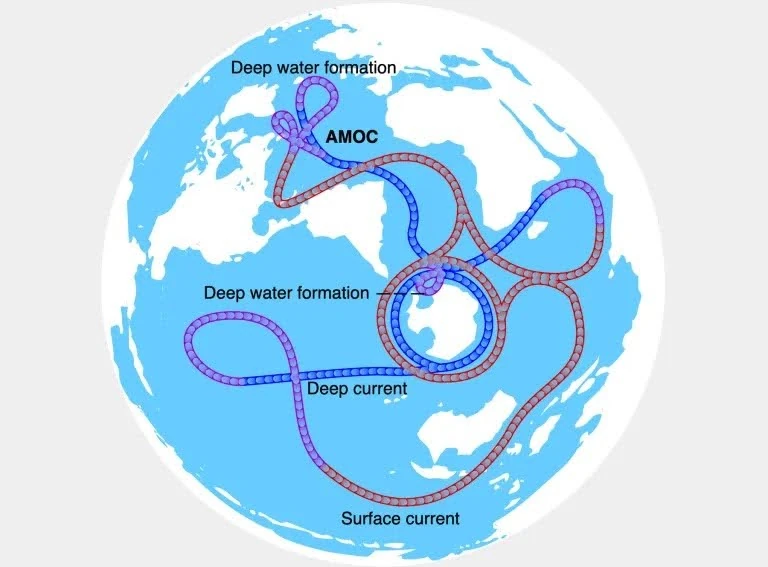
What Is the AMOC and Why Does It Matter
The AMOC is a giant conveyor belt of ocean currents that transports warm water from the tropics to the North Atlantic, where it cools, sinks, and flows back south. This system is responsible for Europe relatively mild climate, regulates global rainfall patterns, and influences monsoon systems that are vital for agriculture in India and Africa.
According to research published in Science News on June 15, 2026, the largest drop in ocean heat content has been concentrated in the top 1,000 metres of the North Atlantic — exactly where the AMOC delivers its heat. The cold blob is the fingerprint of this decline.
The Cold Blob Explained
The cold blob refers to a region south of Greenland where sea surface temperatures have been anomalously cold despite global warming. As the AMOC weakens, it delivers less warm water to this region, causing it to cool even as the rest of the planet warms. Observations from mid-2026 show the cold blob reappearing after a brief pause, with one tracking index flipping negative again.
"The decline in lateral ocean heat transport into the subpolar gyre is the definitive cause of the cold blob," researchers concluded. "As the AMOC slows, it fails to deliver the thermal energy that once buffered the North Atlantic against the chill."
Approaching a Tipping Point
Paleoclimatic proxy data suggests the AMOC is currently at its weakest state in over a millennium. Scientists have identified a secondary feature — a strip of strong warming along the North American coast north of Cape Hatteras — as the other half of the AMOC fingerprint. As the circulation weakens, the Gulf Stream undergoes a distinct northward shift, piling up warm water along the US East Coast and accelerating sea level rise there.
If the AMOC were to cross a tipping point and collapse, the consequences would be catastrophic: disrupted monsoon patterns across South Asia, cooler winters in Europe, faster sea level rise along the US East Coast, and shifts in marine ecosystems.
What This Means for India
The Indian monsoon is closely linked to Atlantic Ocean temperature patterns. A weakened AMOC can alter the temperature gradient between the Indian Ocean and the subcontinent, potentially affecting monsoon timing and intensity. India agriculture, which employs nearly half the workforce, remains heavily dependent on predictable monsoon rainfall. Indian climate scientists at IITM Pune and IISc Bangalore are actively monitoring AMOC trends as part of the country climate adaptation planning.
Sources: Science News, ScienceDaily, CNN, Ocean2Climate, WebProNews