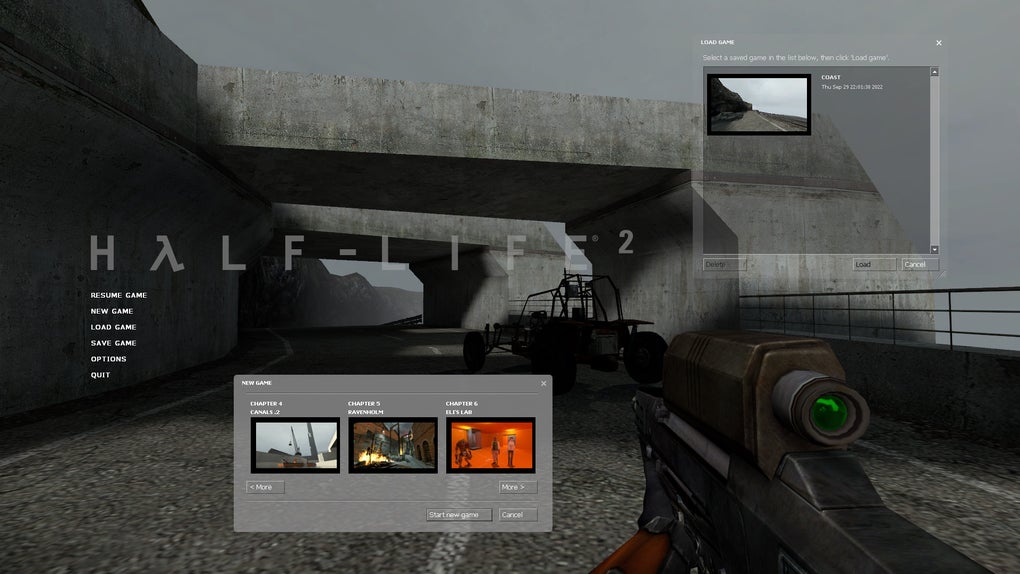
The Long-Awaited Browser Port Is Here
Half-Life 2, Valve's landmark 2004 first-person shooter that redefined narrative-driven gaming, is now playable directly in web browsers thanks to a community-driven Emscripten port. The project, hosted at hl2.slqnt.dev, uses a WebAssembly (WASM) compiled version of the Source engine to run the entire game client-side with no downloads, plugins, or special software required.
The port, built on top of the open-source Xash3D engine and Emscripten transpilation pipeline, compiles the original C++ Source engine codebase into WASM bytecode that modern browsers can execute natively. Players can jump into City 17, fight Combine forces, and experience Gordon Freeman's journey directly from Chrome, Firefox, or Edge on any reasonably modern machine.
How Emscripten and WebAssembly Make It Possible
Emscripten is an open-source compiler toolchain that converts C and C++ code into WebAssembly, a low-level binary format supported by all major browsers. The project takes Half-Life 2 source code and recompiles it for the web runtime environment, translating OpenGL rendering calls to WebGL, mapping DirectSound audio to the Web Audio API, and converting Win32 input handling to DOM events and gamepad APIs.
Performance is surprisingly robust. On a modern laptop with an Intel i7 processor and integrated graphics, the browser port achieves 45-60 frames per second at 720p resolution — comparable to the original 2004 experience. The developers have implemented progressive texture loading and adaptive quality scaling to ensure smooth gameplay across a wide range of devices, including recent Chromebooks and ARM-based laptops.
What the Browser Port Supports
The current version includes the full single-player campaign, from the dystopian opening in City 17 through the iconic airboat chase, the harrowing Ravenholm segment, and the final confrontation at the Citadel. Physics interactions — the gravity gun puzzles, explosive barrel chain reactions, and environmental manipulation — are all faithfully reproduced.
Keyboard and mouse controls work natively, and controller support has been added via the Gamepad API, making the port playable on Steam Deck, Android tablets, and some phones with a Bluetooth controller. Save-game functionality uses the browser's IndexedDB storage, persisting progress across sessions. The port does not currently support multiplayer, modding, or custom maps.
Implications for Game Preservation and Web Gaming
The successful port of a major AAA title to the browser marks a milestone for game preservation. As browser engines continue to improve — with WebGPU offering near-native graphics performance and WASM enabling complex game logic — the barrier between native and web games continues to shrink.
For gamers in India and other emerging markets where high-end gaming PCs remain expensive, browser gaming offers a powerful alternative. A Chromebook or laptop costing under Rs 30,000 can now play a bona-fide classic of the medium without hardware upgrades or software purchases.
How to Play
Navigate to hl2.slqnt.dev on Chrome 120+, Firefox 120+, Edge 120+, or Safari 17+. The game requires approximately 4GB of system RAM and a GPU supporting WebGL 2.0. Initial load takes 30-60 seconds as the engine compiles shaders and decompresses assets. A stable internet connection of at least 10 Mbps is recommended for the first play session.
Sources: Half-Life 2 Web Port, GitHub Repository, Reddit Community Discussion, Emscripten Documentation
For related Voxlogue context, read Google Research's TimesFM 2.5: Open-Source AI Model That Can Forecast Anything from Stock Markets to Weather, and DiffusionGemma: Google Open-Source Model Generates Text 4x Faster Using Image-Style Diffusion.