OpenAI Unveils Three-Tier Frontier Model Family
OpenAI has announced the limited preview of its GPT-5.6 model family, introducing three distinct capability tiers — Sol, Terra, and Luna — in a strategic departure from the company's previous single-model pricing approach. The move marks a fundamental shift in how frontier AI is packaged and priced for enterprise developers, with the Terra tier delivering performance comparable to GPT-5.5 at half the cost.
The preview, announced on June 26, 2026, comes as ChatGPT's market share has fallen below 50 percent amid intensifying competition from Anthropic, Google, and open-source alternatives. OpenAI's new tiered strategy appears designed to capture a broader range of enterprise budgets, from cost-sensitive high-volume deployments to mission-critical reasoning tasks.
Breaking Down the Three Tiers: Sol, Terra, and Luna
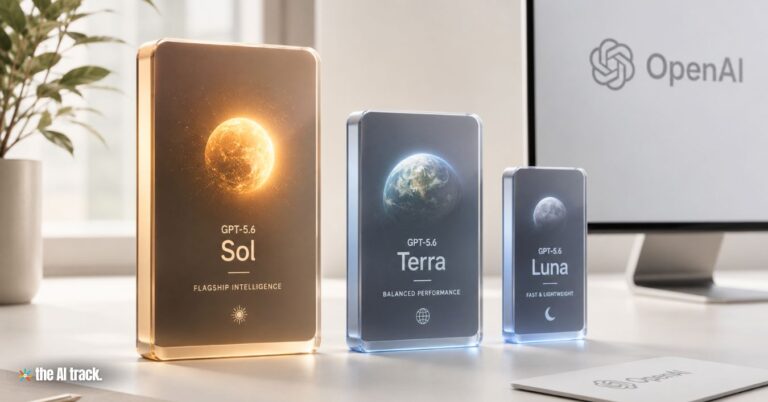
The GPT-5.6 family consists of three models, each optimized for different workload profiles:
| Model | Positioning | Input per 1M Tokens | Output per 1M Tokens |
|---|---|---|---|
| GPT-5.6 Sol | Flagship frontier reasoning | $5.00 | $30.00 |
| GPT-5.6 Terra | Balanced everyday model | $2.50 | $15.00 |
| GPT-5.6 Luna | Fast, low-cost option | $1.00 | $6.00 |
Sol is designed for the hardest problems — complex coding, scientific reasoning, long-horizon agentic planning, and cybersecurity research. It sets a new state-of-the-art on Terminal-Bench 2.1 at 91.9 percent and achieves a 96.7 percent capture-the-flag rate in internal cybersecurity testing. Sol introduces both max reasoning effort and an ultra mode that deploys sub-agents for complex multi-step tasks.
Terra targets high-volume enterprise deployments at scale. It delivers GPT-5.5-competitive performance at 2x lower cost, making it the most significant pricing development in the preview. At $2.50 per million input tokens and $15 per million output tokens, Terra undercuts Sol by 50 percent while maintaining near-flagship quality for customer support, document analysis, and internal tooling.
Luna is the most affordable option, priced at $1 per million input tokens and $6 per million output tokens — making it the cheapest frontier-class model in OpenAI's lineup. Despite its lower cost, Luna earned High ratings in both cybersecurity and biology safety evaluations, making it suitable for a wide range of high-frequency, low-latency tasks.
How GPT-5.6 Compares to Existing Models
The GPT-5.6 family arrives at a time when the AI pricing landscape is rapidly shifting. Anthropic recently released Claude Opus 4.8 and is preparing its Mythos-class models for enterprise customers. Google has countered with Gemini 3.5 Flash with native computer-use capabilities. OpenAI's Terra tier, priced identically to GPT-5.4 at $2.50/$15 per million tokens, directly challenges these competitors on cost.
On ExploitBench, GPT-5.6 Sol slightly outperforms Claude Mythos 5 while using roughly 80 percent fewer output tokens. OpenAI claims Sol sets new high-water marks across coding, scientific reasoning, and agentic workflow evaluations. The model is also being deployed on Cerebras hardware, achieving up to 750 tokens per second — 5 to 15 times faster than most current frontier models.
Limited Preview and Government Coordination
Access to GPT-5.6 Sol, Terra, and Luna is initially restricted to a limited group of trusted partners and organizations, coordinated with the U.S. government. OpenAI says the phased release provides additional time for safety testing and coordination before broader availability. The models are not available in ChatGPT during the preview period.
The preview includes a new GPT-5.6 System Card that details safety evaluations across multiple dimensions, including cyber capabilities, biological misuse potential, and persuasion risks. All three models cross OpenAI's High cyber threshold in internal capture-the-flag testing, with significant safeguards applied proportional to each tier's capabilities.
What the Tiered Pricing Means for Developers
The introduction of tiered pricing has significant implications for AI developers and enterprises. The GPT-5.6 family introduces more predictable prompt caching, including explicit cache breakpoints and a 30-minute minimum cache life. Cache writes are billed at 1.25x the uncached input rate, while cache reads receive the standard 90 percent discount.
For Indian enterprises and startups, the Terra tier at $2.50/$15 per million tokens offers a compelling value proposition for high-volume AI workloads. Combined with Meta's $145 billion AI capex push and OpenAI's custom Jalapeño inference chip, the cost of frontier AI inference is on a clear downward trajectory.
Competitive Landscape and Market Impact
The three-tier naming system — Sol, Terra, Luna — represents a durable capability structure where each tier can advance on its own cadence. This is a departure from OpenAI's earlier approach where a single model version had to serve all use cases. Analysts expect the tiered approach to pressure competitors to offer similar flexibility, potentially accelerating the overall commoditization of frontier AI inference.
OpenAI plans to expand availability in the coming weeks but has not announced a general-availability date. During the preview, approved participants can access the models through the OpenAI API, Codex, or both, depending on their organization's approval status.
Frequently Asked Questions
Can anyone use GPT-5.6 Sol during the preview?
No. Access during the preview is limited to approved partners and organizations whose participation has been shared with the U.S. government. OpenAI plans to expand availability as soon as possible.
How does GPT-5.6 Terra compare to GPT-5.5?
Terra delivers GPT-5.5-competitive performance at 2x lower cost. OpenAI positions it as a balanced everyday model ideal for high-volume enterprise workloads like customer support, document pipelines, and internal API tools.
Is GPT-5.6 available on ChatGPT?
No. During the preview period, GPT-5.6 Sol, Terra, and Luna are available only through the OpenAI API and Codex. ChatGPT integration has not been announced.
What pricing does GPT-5.6 Luna offer?
Luna is priced at $1 per million input tokens and $6 per million output tokens, making it OpenAI's cheapest frontier model. It is optimized for high-frequency, low-latency tasks such as summarization, classification, and lightweight automation.
Sources: OpenAI — Previewing GPT-5.6 Sol, OpenAI Help Center — GPT-5.6 Preview, VentureBeat — OpenAI Unveils GPT-5.6, OpenAI Developer Community, OpenAI — GPT-5.6 Preview System Card