
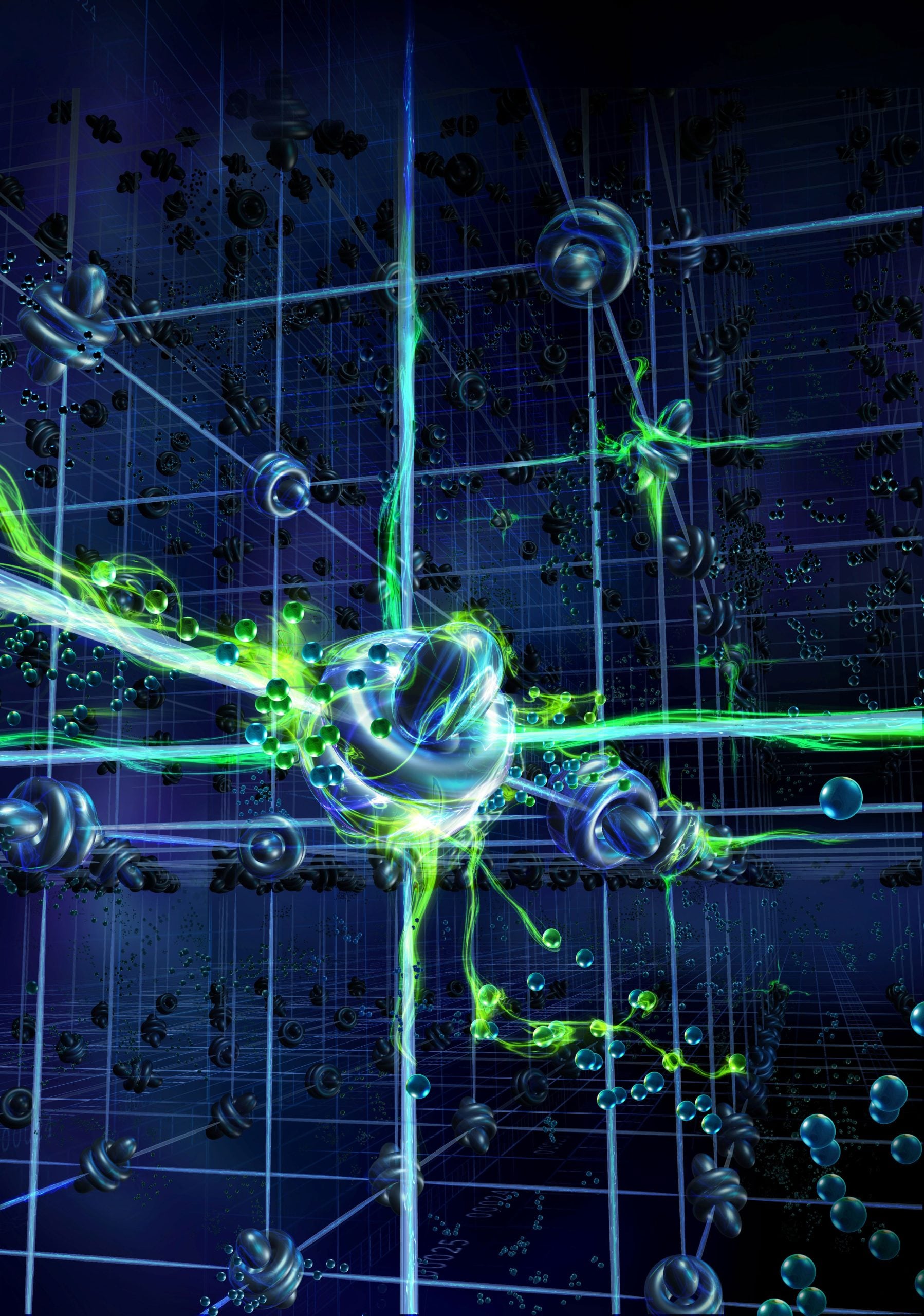
Quantum Entanglement Goes Macroscopic
Physicists at TU Wien have detected a high degree of quantum entanglement inside a centimeter-sized crystal made of cerium, palladium and silicon — a so-called strange metal that defies conventional electrical and magnetic behavior. The discovery shatters the assumption that quantum effects are confined to isolated atoms and photons, showing that even objects large enough to hold in your hand can exhibit deeply quantum behavior.
Published in Nature Physics, the study used a technique from quantum information science called quantum Fisher information to analyze how the crystal responded to neutron bombardment at the Institut Laue-Langevin in Grenoble. Instead of a single particle absorbing the neutron's energy, the data revealed that groups of at least nine quantum-entangled particles responded collectively — direct evidence of multipartite entanglement in a macroscopic solid. This builds on earlier breakthroughs in AI-driven molecular design that have transformed how scientists study materials at the quantum scale.
Why a 'Strange Metal' Was the Perfect Test Subject
Strange metals are materials where electrical resistivity scales linearly with temperature, unlike the quadratic behavior of conventional metals. They also appear in high-temperature superconductors, making them one of the most actively studied classes of quantum materials. The TU Wien team chose a crystal of CePdSi (cerium-palladium-silicon), a strange metal already known for unusual quantum properties, many still not fully understood. Researchers have previously reconstructed ancient enzymes dating back billions of years using similar techniques to probe fundamental biological mechanisms.
In a collaboration with Rice University in 2025, the same group found that electrical current flows through strange metals with unusually low electrical noise. The discovery of entanglement now offers a compelling explanation: particles do not vanish but instead coordinate their behavior, suppressing random current fluctuations through collective quantum coherence.
From Schrödinger's Cat to an Anthill
Erwin Schrödinger famously asked whether a cat could be both dead and alive. The TU Wien experiment takes a different approach. "We do not try to bring the crystal into a superposition of two states," explains Prof. Silke Bühler-Paschen from the Institute of Solid State Physics at TU Wien. "Instead, we ask whether its constituents are collectively in such a state of entanglement."
She compares the result to an anthill: when disturbed, the entire colony reacts as one, not individual ants. When the crystal was probed with neutrons, the response came from at least nine entangled entities acting together — a collective quantum phenomenon never before seen at this scale in a solid material.
Quantum Fisher Information: The Mathematical Key
The theoretical groundwork was laid by Innsbruck quantum physicist Peter Zoller and his team. They showed that quantum Fisher information — a measure of how sensitively a system responds to changes — can detect entanglement even in extraordinarily complex many-body systems. For independent particles, the response is limited to the sum of individual contributions. But if particles are entangled, the system responds more strongly than the sum of its parts.
"This enhanced sensitivity is precisely what makes entanglement such a valuable resource for quantum metrology," says Bühler-Paschen. The ability to detect extremely small signals with exceptional precision could lead to next-generation quantum sensors, much as the AlphaFold system revolutionised computational biology by revealing molecular structures at unprecedented resolution.
What This Means for Quantum Technology
The discovery has immediate implications for quantum sensing and metrology. Strange metals that naturally host robust entanglement could serve as ready-made platforms for ultra-sensitive detectors, bypassing the need to engineer fragile quantum states atom by atom. The team's next goal is to explore whether strange metals could find direct applications in quantum technologies, particularly high-precision measurements.
"What we see here is not a detail of one particular material, but a general physical principle," says Fakher Assaad from the University of Würzburg, lead theorist of the study. "Strong entanglement appears to be directly linked to the unusual behavior of strange metals."
India Impact: Positioning in the Global Quantum Race
India's National Quantum Mission, with a budget of ₹6,003 crore, aims to build quantum computers, communication networks, and sensors by 2031. The TU Wien discovery underscores that macroscopic quantum materials may offer a faster path to practical quantum sensors than building systems from isolated qubits. Indian research institutions like the IISc, TIFR, and IITs are actively studying strongly correlated materials, and this breakthrough highlights the potential payoffs of fundamental quantum materials research.
FAQ
What exactly is quantum entanglement?
Quantum entanglement is a phenomenon where two or more particles become linked so that measuring one instantly influences the state of the other, regardless of distance. Einstein called it "spooky action at a distance." The TU Wien experiment shows that this linkage can occur collectively across many particles inside a solid crystal.
Why is this discovery significant?
Previous demonstrations of entanglement required isolated atoms, photons, or microscopic systems at cryogenic temperatures. This is the first time high-degree multipartite entanglement has been detected in a centimeter-sized solid material that can be held in your hand, bridging the gap between quantum and classical physics.
What is a strange metal?
Strange metals are materials where electrical resistance increases in direct proportion to temperature, unlike normal metals where it follows a square law. They are also closely related to high-temperature superconductors and are considered one of the most mysterious states of quantum matter.
Could this lead to practical applications?
Yes. Strange metals that naturally host entanglement could be used as platforms for ultra-sensitive quantum sensors, magnetometers, and thermometers without requiring the complex isolation needed for conventional quantum setups.
Sources
Sources:


