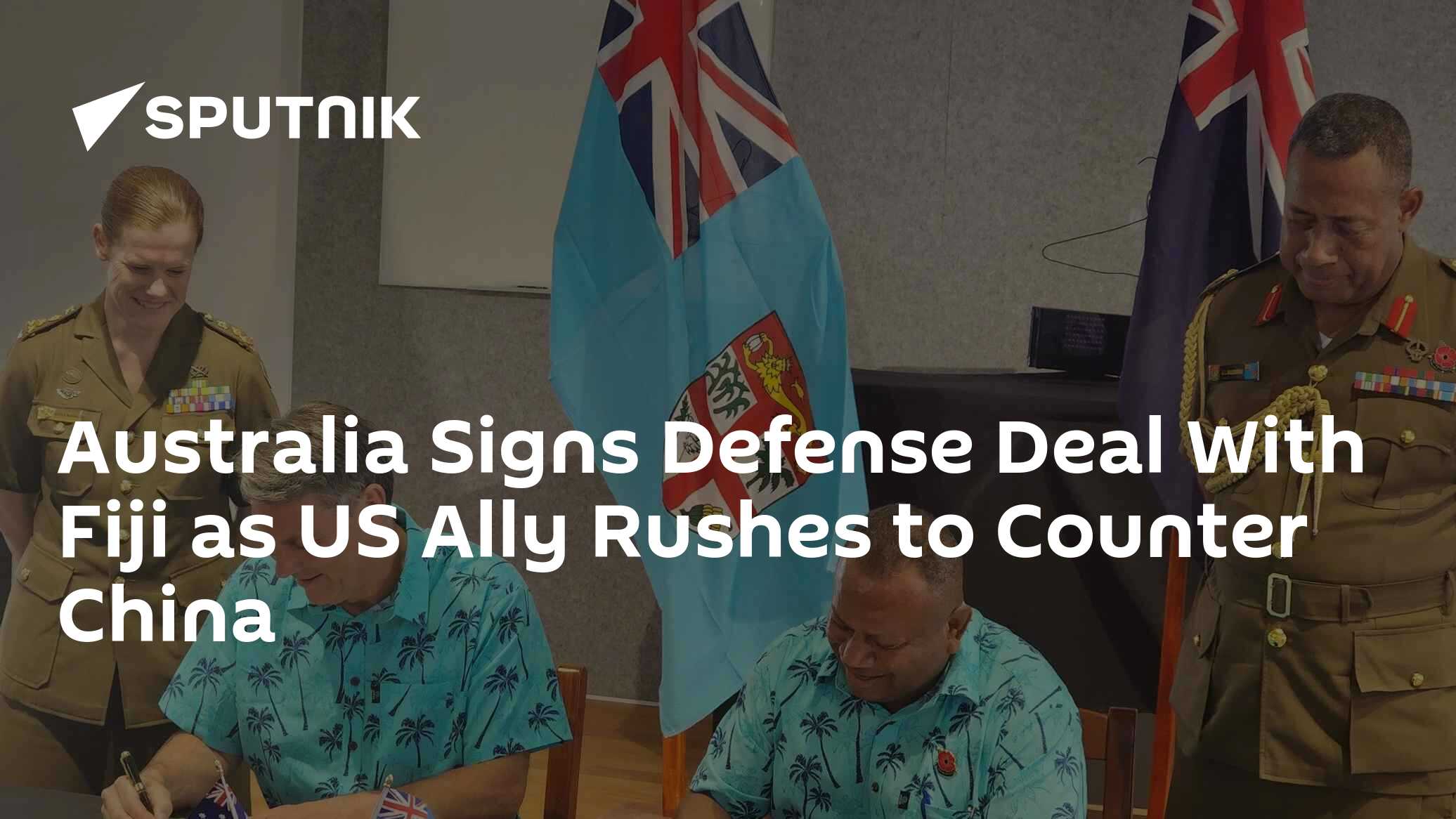
Australia and Fiji signed the Ocean of Peace Alliance on July 6, 2026, a landmark mutual defence treaty that marks Fiji's first such alliance and Australia's fourth treaty-bound security partnership. Just hours after the signing ceremony in Suva, China test-launched a submarine-launched ballistic missile into the South Pacific, in what analysts describe as a deliberate signal to the new security alignment, amid escalating Chinese military assertiveness across the region.
Ocean of Peace Alliance: What the Treaty Contains
The Ocean of Peace Alliance commits Australia and Fiji to mutual defence obligations, binding each nation to “act to meet the common danger” in the event either country is attacked. The treaty was signed by Australian Prime Minister Anthony Albanese and Fijian Prime Minister Sitiveni Rabuka at the Grand Pacific Hotel in Suva.
Alongside the defence pact, the two leaders also signed the Vuvale Union, a comprehensive economic treaty under which Australia will invest over 1 billion Australian dollars (approximately $693 million USD) in Fiji over a decade, covering areas from climate action to economic cooperation.
The alliance includes a clause allowing other Pacific nations to join later, paving the way for participation by Papua New Guinea, Tonga, and New Zealand — the three other Pacific nations with standing militaries. The agreement is part of Australia’s broader Pacific strategy, following the Pukpuk Treaty with Papua New Guinea signed last year and the Nakamal Agreement with Vanuatu finalised in June 2026.
“When it comes to security issues, the Pacific family need to look after our own security,” Albanese told reporters in Suva. “The significance of these agreements cannot be underestimated.”
China’s Pacific Missile Test: Timing and Strategic Message
On the same day as the treaty signing, a Chinese nuclear-powered Type 094A Jin-class ballistic missile submarine test-launched a long-range ballistic missile with a dummy warhead into the South Pacific. The missile landed in the South Pacific Nuclear Free Zone, drawing immediate criticism from Australia and regional partners.
Chinese official media confirmed the test, stating it was a routine exercise. However, regional security analysts widely interpret the timing as a deliberate message. Combined with ongoing maritime disputes across the region, the missile test signals Beijing’s willingness to project force. China last publicly conducted an intercontinental ballistic missile test in 2024, making the 2026 launch its first in two years.
Australia’s Foreign Minister Penny Wong, who was in Fiji for the signing, did not comment directly on whether China had attempted to send a message. However, Australian officials expressed concern about the lack of prior notification and the missile’s impact zone within the South Pacific Nuclear Free Zone.
“China’s missile test coincided with the signing of the Australia-Fiji defence pact and allied military drills across the region,” noted Radio Free Asia, quoting analysts who said the move was aimed at signaling China’s growing military reach to US allies.
Regional Reaction and Geopolitical Context
Fiji’s Prime Minister Rabuka sought to downplay the likelihood of Chinese pushback, telling reporters: “I do not expect China to have any severe pushback on either government. I believe they will welcome the understanding between Australia and Fiji.”
The Ocean of Peace Alliance follows a series of Australian diplomatic wins in the Pacific. Last week, Australia and Vanuatu signed a long-awaited bilateral security and economic treaty that prevents any foreign nation from establishing a military base on Vanuatu. The Pukpuk Treaty with Papua New Guinea, Australia’s nearest neighbour, officially came into effect on July 8, 2026.
China, for its part, has previously warned Canberra against playing “geopolitical games” in the Pacific. Beijing has spent hundreds of millions of dollars building sports stadiums, presidential palaces, hospitals, and roads across Pacific island nations as part of its Belt and Road Initiative.
The developments carry implications for India as well, given New Delhi’s growing strategic engagement with the Pacific Islands through the Forum for India-Pacific Islands Cooperation (FIPIC) and its broader Indo-Pacific vision. India has expanded development partnerships with Fiji, Papua New Guinea, and other Pacific nations in recent years.
What This Means for Pacific Security Architecture
Fiji joins the United States, New Zealand, and Papua New Guinea as Australia’s fourth treaty ally. The alliance fundamentally reshapes the Pacific security landscape, creating a network of mutual defence obligations across the region’s key island nations.
Pacific affairs expert Tess Newton Cain noted that the open-access clause was clearly aimed at Pacific nations with standing militaries. “The architecture now includes overlapping treaties that collectively send a strong signal about collective security,” she told media.
The timing of China’s missile launch underscores the heightened strategic competition in the region. With the United States focused on the Iran conflict and European security, Australia has taken a leading role in Pacific security architecture, forging bilateral treaties that create a web of mutual defence commitments.
FAQ
What is the Ocean of Peace Alliance?
It is a mutual defence treaty signed between Australia and Fiji on July 6, 2026, committing both nations to defend each other if attacked. It is Fiji's first defence alliance and Australia's fourth.
Why did China test a missile on the same day?
Analysts believe China's submarine-launched ballistic missile test was timed to signal Beijing's displeasure with the new security alignment and demonstrate China's ability to project power across the Pacific.
Can other Pacific nations join the alliance?
Yes. The treaty includes a clause allowing other Pacific countries to join, with Papua New Guinea, Tonga, and New Zealand as likely future participants.
How does this affect India's interests?
India has been expanding its development and security partnerships with Pacific Island nations through FIPIC and India's Indo-Pacific policy. A more structured Pacific security framework creates both opportunities and strategic considerations for New Delhi.
Sources
- The Guardian: Australia and Fiji sign surprise defence alliance
- BBC: China tests missile in Pacific after Australia-Fiji alliance signed
- NPR: China test-launches ballistic missile in South Pacific
- Sydney Morning Herald: Australia to spend $1 billion on defence alliance with Fiji
- Radio Free Asia: China's Pacific missile test sends message to US allies