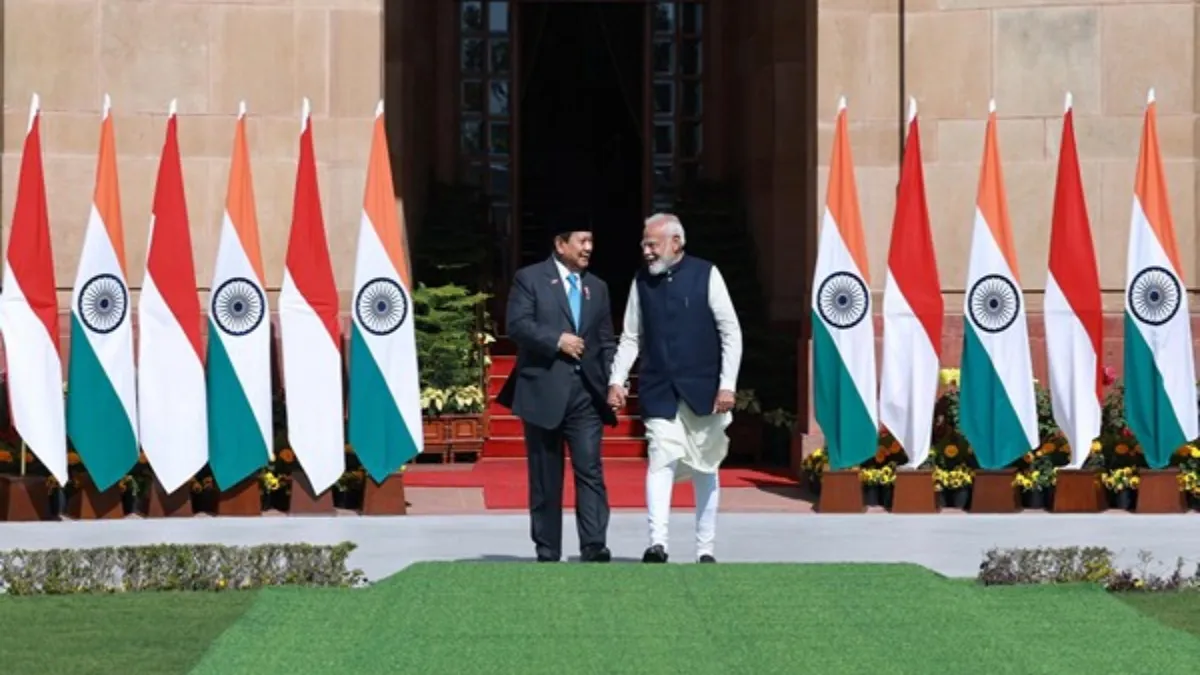
India and Indonesia on Tuesday sealed a landmark defence agreement for the supply of BrahMos supersonic cruise missiles to the Indonesian military, marking one of India's largest-ever defence export deals. The agreement was signed during Prime Minister Narendra Modi's two-day visit to Jakarta at the invitation of Indonesian President Prabowo Subianto.
BrahMos Deal Details and Strategic Significance
The deal, estimated to be worth around $630 million (₹5,985 crore), makes Indonesia the third foreign buyer of the BrahMos missile system after the Philippines and Vietnam. The BrahMos, jointly developed by India and Russia, is among the world's fastest cruise missiles and can be launched from land, sea, and air platforms. India also signed an agreement to supply Astra beyond-visual-range air-to-air missiles to Indonesia, which can be integrated on the Russian-made Sukhoi fighter jets operated by the Indonesian Air Force.
The agreement underscores India's expanding role as a defence manufacturing partner in the Indo-Pacific region. Global interest in the BrahMos system has surged following India's combat deployment of the missile during Operation Sindoor against Pakistan-backed terror groups, marking the weapon's first operational use in conflict.
20 Agreements Across Defence, Trade, and Space
During the visit, the two nations exchanged more than 20 bilateral documents covering a wide spectrum of cooperation. Key agreements included maritime safety and security, space exploration, defence industrial cooperation, critical minerals and rare earths, steel supply chain technology, health workforce collaboration, and disaster management.
Notably, a Strategic Joint Venture between the Steel Authority of India (SAIL) and PT Krakatau Steel will establish a stainless-steel slab manufacturing facility in Indonesia. The two countries also finalised a framework on maritime safety and security cooperation and signed an agreement on minerals and technologies for the steel supply chain.
MEA spokesperson Randhir Jaiswal said the BrahMos agreement "demonstrates the capability of the Indian defense industry", strengthens "Atmanirbhar Bharat", and boosts indigenous defence manufacturing and exports. The Air-to-Air Missile Cooperation Agreement similarly enhances India's indigenous missile development ecosystem.
Indonesia Honours PM Modi with Highest Civilian Award
In a special gesture reflecting the deep bilateral ties, President Prabowo Subianto conferred the 'Bintang Adipurna' — Indonesia's highest civilian honour — upon Prime Minister Modi. The award was announced during the state visit, highlighting the elevated strategic partnership between the two democracies.
PM Modi held official talks with President Prabowo at the Istana Merdeca (Merdeka Palace) in Jakarta. The leaders reviewed the full spectrum of the India-Indonesia Comprehensive Strategic Partnership, covering trade and investment, defence and security, maritime cooperation, energy, healthcare and pharmaceuticals, space, critical minerals and rare earths, culture, tourism, and people-to-people exchanges.
Indo-Pacific Implications and China Competition
The defence deal is widely seen as a strategic move to deepen India's security footprint in Southeast Asia amid growing Chinese assertiveness in the South China Sea and the wider Indo-Pacific region. Indonesia, as Southeast Asia's largest economy, is a critical pillar of India's Act East Policy and central to its vision of a free and open Indo-Pacific.
India and Indonesia share longstanding historical and civilisational ties, with PM Modi's visit being his fourth to the country. On his first trip in 2018, relations were upgraded to a Comprehensive Strategic Partnership. He also attended the G20 Summit in Indonesia in 2022 and the ASEAN Summit in 2023.
Earlier tensions in the Strait of Hormuz had disrupted global energy markets, and India has been actively securing its energy supply chains while deepening strategic partnerships across the region. The BrahMos deal signals that India is increasingly positioning itself as a security provider in its neighbourhood and beyond, competing with China for influence in Southeast Asia.
From Jakarta, PM Modi will continue his week-long Indo-Pacific tour to Australia and New Zealand, where similar defence and economic cooperation discussions are expected.
Broader India-Indonesia Economic Engagement
Beyond defence, the two sides signed MoUs on the peaceful exploration of outer space, maritime safety cooperation, and health workforce collaboration. The space cooperation agreement is expected to open new avenues for joint satellite development and launch services, while the maritime safety framework aims to enhance coordination in one of the world's busiest sea lanes.
Prime Minister Modi also visited the iconic Prambanan Temple, a UNESCO World Heritage site, posting a video on social media that highlighted the shared Hindu-Buddhist heritage between India and Indonesia. "You'll find India's cultural heritage across the world," Modi remarked, underscoring the civilisational links that underpin modern strategic relations.
For related coverage, read about the 6.7-magnitude earthquake that struck Indonesia's Sulawesi Island and PM Modi's diplomatic engagements at the G7 Summit.
FAQs
What is the BrahMos missile?
The BrahMos is a supersonic cruise missile jointly developed by India and Russia. It is among the world's fastest cruise missiles, capable of being launched from land, sea, and air platforms.
How much is the India-Indonesia BrahMos deal worth?
The deal is estimated at approximately $630 million (₹5,985 crore).
Which other countries have bought the BrahMos missile?
The Philippines and Vietnam are the other two foreign buyers of the BrahMos system.
What other agreements were signed during Modi's visit?
Over 20 agreements were signed covering defence, space exploration, critical minerals, steel supply chain, maritime safety, health collaboration, and disaster management.
Why is Indonesia strategically important for India?
Indonesia is Southeast Asia's largest economy and a key pillar of India's Act East Policy. It is strategically located along critical sea lanes and competes with China for influence in the Indo-Pacific region.