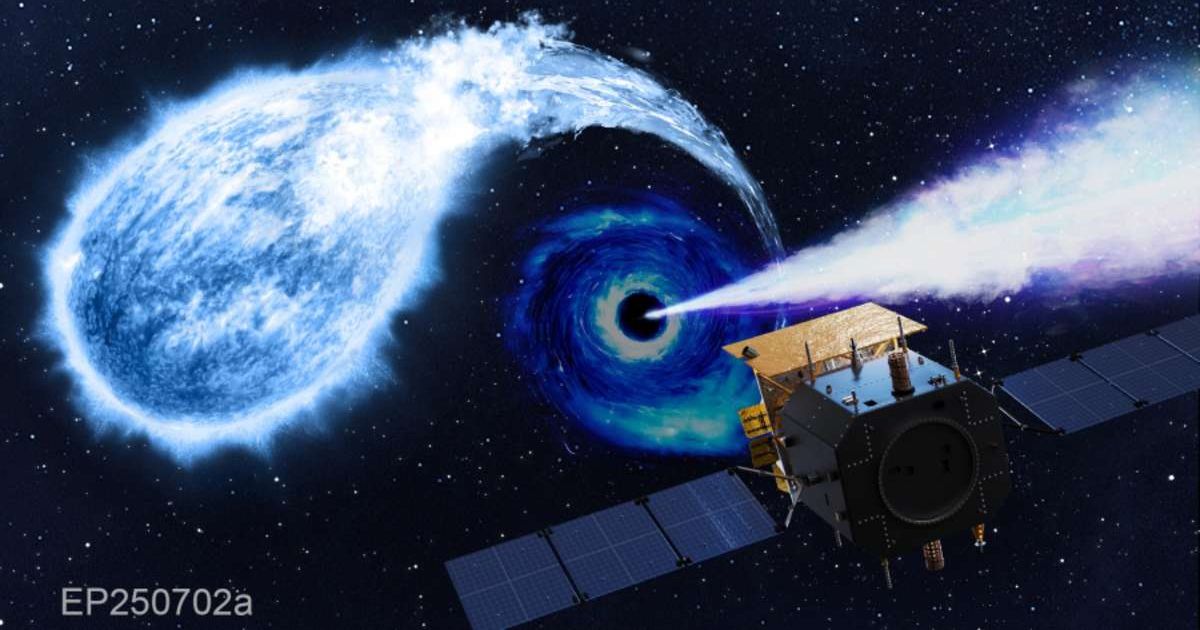
Astronomers may have witnessed one of the rarest and most dramatic cosmic events ever recorded — a long-sought intermediate-mass black hole ripping apart a dense white dwarf star and devouring it in a spectacular display of energy. The discovery, made by China’s Einstein Probe space telescope, was published as a cover article in Science Bulletin in February 2026 and is described as the first direct observational evidence of such an extreme black hole feeding event.
If confirmed, the event — designated EP250702a — would open a new window into the mysterious population of intermediate-mass black holes (IMBHs), which have long eluded astronomers despite decades of searching. These objects are considered the missing link between stellar-mass black holes, which form when massive stars collapse, and the supermassive black holes that lurk at the centre of nearly every large galaxy.
Also read: Astronomers Discover Sleeping Giant Black Hole 6 Billion Times the Sun Mass
How the Einstein Probe Caught the Event
The Einstein Probe (EP), also known in Chinese as Tianguan, was launched in January 2024 as a joint project between the Chinese Academy of Sciences (CAS), the European Space Agency (ESA), and the Max Planck Institute for Extraterrestrial Physics. It is equipped with innovative lobster-eye micro-pore optics that give it an exceptionally wide field of view, allowing it to monitor large swaths of the sky for transient X-ray sources.
During a routine sky survey on July 2, 2025, the Wide-field X-ray Telescope (WXT) detected a rapidly varying X-ray source that stood out from typical cosmic explosions. The source, later designated EP250702a (also known as GRB 250702B), exhibited a set of features that no existing model could fully explain.
Almost simultaneously, NASA’s Fermi Gamma-ray Space Telescope recorded a series of gamma-ray bursts from the same region, prompting an immediate international follow-up campaign. The Follow-up X-ray Telescope (FXT) on the Einstein Probe monitored the event’s evolution over approximately 20 days, while ground-based observatories across the world trained their instruments on the location.
Why This Event Is Unlike Anything Seen Before
EP250702a displayed several highly unusual characteristics that set it apart from ordinary gamma-ray bursts or supernova explosions:
Early X-ray precursor. The WXT detected a steady X-ray signal approximately 24 hours before the gamma-ray burst appeared — a sequence that has never been observed in standard cosmic explosions. This early signal was crucial in ruling out conventional explanations.
Extreme peak luminosity. The event reached a peak luminosity of approximately 3 × 10¹⁹ erg per second, placing it among the brightest instantaneous outbursts ever recorded in the universe.
Rapid evolution. The brightness faded by a factor of more than 100,000 over roughly 20 days — an extraordinarily fast decline compared to typical tidal disruption events.
Hard-to-soft spectral transition. The emission shifted from hard (high-energy) X-rays to soft (low-energy) X-rays over the course of the event, with the photon index changing from approximately 1 to more than 3. This is the first time such a spectral evolution has been observed in this type of event and suggests the emergence of a thermal radiation component from the disrupted stellar debris at later times.
Location. The event occurred in the outskirts of a distant galaxy, away from the galactic centre, making it incompatible with typical active galactic nucleus (AGN) activity.
The White Dwarf and Intermediate-Mass Black Hole Scenario
After thoroughly evaluating multiple theoretical explanations — including ordinary gamma-ray bursts, supernova explosions, and AGN flares — one scenario emerged as the strongest candidate: an intermediate-mass black hole tearing apart and consuming a white dwarf star.
A white dwarf is the extremely dense remnant of a Sun-like star that has exhausted its nuclear fuel. With average densities up to a million times that of the Sun, these compact objects are so dense that only black holes within a specific mass range can tear them apart instead of swallowing them whole.
Intermediate-mass black holes, ranging from hundreds to hundreds of thousands of solar masses, possess the unique combination of gravitational force and compact size needed to shred a white dwarf. Supermassive black holes would swallow a white dwarf whole without producing the observed fireworks, while stellar-mass black holes lack the gravitational reach to capture such a compact object.
Professor Lixin Dai from the University of Hong Kong (HKU), a co-corresponding author of the study, explained: “The white dwarf–intermediate-mass black hole model can most naturally explain its rapid evolution and extreme energy output.”
Dr Jinhong Chen, a postdoctoral fellow at HKU, added: “Our computational simulations show that the combination of the tidal forces of an intermediate-mass black hole, combined with the extreme density of a white dwarf, can produce jet energies and evolutionary timescales that are highly consistent with the observational data.”
The black hole mass was constrained to no more than 75,000 solar masses by analysing the rapid flux variability of the source, effectively ruling out the possibility of a supermassive black hole.
Why Intermediate-Mass Black Holes Matter
Intermediate-mass black holes are one of the most elusive objects in modern astrophysics. While astronomers have extensively studied stellar-mass black holes (a few to tens of solar masses) and supermassive black holes (millions to billions of solar masses), the intermediate range has remained frustratingly difficult to detect.
These objects are considered crucial for understanding how black holes grow across cosmic time. Theoretically, IMBHs could be seeds that eventually grow into the supermassive black holes found at the centre of galaxies like our own Milky Way. However, without direct observational evidence, their very existence had remained somewhat uncertain.
If EP250702a is confirmed as an IMBH-white dwarf tidal disruption event, it would provide the first clear evidence that IMBHs not only exist but can be actively studied through the dramatic signatures they produce when feeding on compact stellar objects.
The discovery also demonstrates the power of the Einstein Probe’s wide-field survey strategy. As Professor Weimin Yuan, Principal Scientist of the Einstein Probe mission at NAOC, stated: “The discovery of EP250702a fully demonstrates our capability to be the first to capture the universe’s most extreme moments.”
Also read: NASA Cold Atom Lab Creates Bose-Einstein Condensates in Space
What This Means for Multi-Messenger Astronomy
The event highlights the growing importance of multi-messenger astronomy, where observations across different parts of the electromagnetic spectrum — X-rays, gamma rays, optical, and radio — are combined to build a complete picture of cosmic phenomena. The coordinated response to EP250702a involved not just the Einstein Probe and Fermi but also ground-based optical and radio telescopes worldwide.
Future space missions, including India’s X-ray Polarimeter Satellite (XPoSat) and the proposed Advanced X-ray Timing and Polarimetry mission, could contribute to similar follow-up campaigns. India’s growing role in space-based astronomy, from its Chandrayaan lunar programme to the Aditya-L1 solar mission, positions it as an increasingly important participant in the international multi-messenger astronomy network.
The discovery also demonstrates how space telescopes with innovative optics can uncover entirely new classes of astrophysical phenomena. The lobster-eye micro-pore optics technology used by the Einstein Probe — originally developed in Europe — has proven to be a game-changer for wide-field X-ray monitoring.
For Indian astronomers and space scientists, the EP250702a discovery reinforces the value of investing in wide-field survey capabilities and international collaboration. As India expands its space science programme, the ability to respond quickly to transient events across the electromagnetic spectrum will be critical for making similar breakthrough discoveries.
Frequently Asked Questions
What exactly did the Einstein Probe detect?
The Einstein Probe detected an extremely bright, rapidly varying X-ray source designated EP250702a on July 2, 2025. The event showed unusual characteristics that led researchers to propose it was an intermediate-mass black hole tearing apart a white dwarf star.
What is an intermediate-mass black hole?
An intermediate-mass black hole (IMBH) is a black hole with a mass between about 100 and 100,000 times that of the Sun. They are considered the missing link between stellar-mass black holes (a few to tens of solar masses) and supermassive black holes (millions to billions of solar masses).
What is a white dwarf?
A white dwarf is the extremely dense remnant of a Sun-like star that has exhausted its nuclear fuel. A typical white dwarf packs a mass comparable to the Sun into a volume roughly the size of Earth, giving it an average density up to a million times that of the Sun.
Why has this type of event never been seen before?
Intermediate-mass black holes are extremely difficult to detect because they do not produce the strong signatures that stellar-mass or supermassive black holes do. Additionally, only black holes within a specific mass range can tear apart a white dwarf instead of swallowing it whole, making such events exceptionally rare.
What is the significance of EP250702a for astronomy?
If confirmed, it would provide the first direct observational evidence of an intermediate-mass black hole, confirming the existence of this long-hypothesised class of objects and opening new avenues for studying black hole growth and evolution.
Sources
- ScienceDaily — Einstein Probe may have caught a black hole tearing apart a white dwarf for the first time
- Phys.org — A possible first-ever Einstein probe observation of a black hole tearing apart a white dwarf
- HKU Press Release — HKU Astrophysicists Contribute to Interpreting a Possible First-Ever Einstein Probe Observation
- Chinese Academy of Sciences — Einstein Probe Detects Likely Intermediate-Mass Black Hole Shredding a White Dwarf