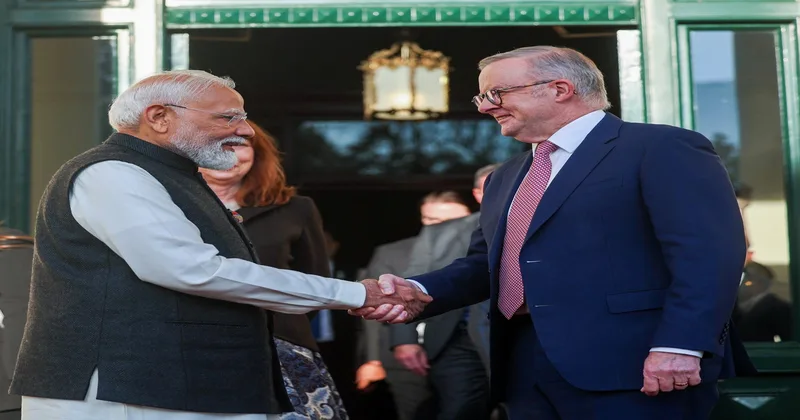
India and Australia on Thursday sealed a landmark uranium supply agreement during Prime Minister Narendra Modi's visit to Melbourne, ending more than a decade of legal and political hurdles that had prevented Australian uranium exports to India. The deal, signed after talks between Modi and Australian Prime Minister Anthony Albanese, marks one of the most significant outcomes of the third India-Australia Annual Summit and opens a new chapter in the bilateral energy partnership.
The administrative arrangement under the 2015 Australia-India Civil Nuclear Agreement will now facilitate the commercial supply of Australian uranium for India's civilian nuclear power programme. Australia holds approximately 28 percent of the world's uranium reserves, making it one of the largest potential suppliers for India's expanding nuclear energy sector.
"We have signed an important agreement today on nuclear energy," Modi said in a joint press conference with Albanese. "This will pave the way for uranium supplies from Australia to India and give our clean energy objectives fresh momentum."
How the Uranium Deal Unlocks India's Nuclear Energy Ambitions
India currently operates 24 nuclear reactors across eight plants with a total installed capacity of about 8.2 GW, accounting for roughly 1.8 percent of the nation's total power capacity. The government has set an ambitious target of expanding this to 100 GW by 2047 — a twelve-fold increase that will require reliable and uninterrupted fuel supplies.
The Australia uranium deal ensures that India's nuclear power plants will have access to high-quality uranium from one of the world's most stable and trusted suppliers. Under the agreement, exports will be strictly for peaceful purposes under International Atomic Energy Agency safeguards.
Australia's uranium reserves are concentrated in South Australia and the Northern Territory, with major deposits at Olympic Dam, Beverley, and Ranger. The country has long sought to diversify its export markets beyond China, its top trading partner, making India a natural strategic partner for long-term uranium supply.
India currently consumes approximately 1,500 to 2,000 tonnes of uranium annually, and the Australia deal will supplement domestic production from mines in Jharkhand, Andhra Pradesh, and Meghalaya. The agreement also reduces India's dependence on uranium imports from Kazakhstan, Canada, and Russia, diversifying supply sources for energy security.
In a related development, the Indian government has already passed the SHANTI Act to enable private sector participation in nuclear power generation, with 10 to 12 companies expected to enter the sector. The Union Budget 2025-26 established a Nuclear Energy Mission with a ₹20,000 crore outlay to develop small modular reactors, targeting five indigenously built SMRs by 2033.
Strategic and Economic Significance of the India-Australia Uranium Pact
The uranium agreement is part of a broader strategic package unveiled during Modi's Melbourne visit. The two sides also signed a Joint Declaration on Defence and Security, a Joint Statement on Energy Cooperation, and a roadmap for collaboration in cyber security, critical technologies, and resilient supply chains.
Beyond nuclear energy, the leaders agreed to establish an India-Australia Defence Innovation Corridor connecting defence start-ups in both countries, and a critical minerals corridor to secure supply chains for lithium, cobalt, and rare earth elements essential for India's electric vehicle and electronics manufacturing ambitions.
The pact also signals Australia's deepening commitment to the Indo-Pacific strategic architecture. Modi described the Indo-Pacific as "not just the confluence of two oceans but also the shared aspirations of like-minded democracies." Both nations are Quad partners along with Japan and the United States, and the uranium deal strengthens the Quad's collective energy security framework.
For Australia, the deal opens a significant new market for its resource sector at a time when global trade conditions remain uncertain. Albanese described India as "one of Australia's most important strategic partners" and said the relationship "has never been more consequential than it is today."
The two countries also agreed to fast-track negotiations on a Comprehensive Economic Cooperation Agreement (CECA) and work towards concluding a bilateral investment treaty. Bilateral trade between India and Australia has grown substantially since the Economic Cooperation and Trade Agreement (ECTA) came into force.
For related coverage on India's broader energy strategy, read about India's Rs 46,000 crore coal gasification plan targeting 100 million tonnes by 2030 and Amazon's $48 billion investment commitment in India following PM Modi's outreach.
What This Means for India's Clean Energy Transition
India has committed to achieving 500 GW of non-fossil fuel power capacity by 2030 and net-zero emissions by 2070. Nuclear power, which provides reliable baseload electricity without carbon emissions, is central to this transition. Unlike solar and wind, nuclear plants operate continuously regardless of weather conditions, making them essential for grid stability as renewable capacity expands.
The uranium deal supports India's energy trilemma: ensuring affordable electricity for 1.4 billion people, reducing carbon emissions, and maintaining energy security. Currently, coal accounts for over 70 percent of India's electricity generation, and the government is pursuing a multi-pronged strategy that includes nuclear, solar, wind, hydro, and green hydrogen.
Industry experts estimate the Australia uranium supply could support an additional 10-15 GW of nuclear capacity over the next decade, depending on how quickly India can build new reactors. The Nuclear Power Corporation of India Limited is expected to develop an additional 32 GW of capacity beyond 2032 using indigenous Pressurised Heavy Water Reactors along with Light Water Reactors.
Modi also signalled possible cooperation in low-carbon aluminium projects and urged Australia's business community to invest long-term in India's road, port, rail, and urban infrastructure projects. The joint statement on energy security noted both countries' "deep concern over the situation in the Middle East and its consequences for our region, including the prolonged impact of disruptions on energy, resources and other important commodities' supply chains and prices."
Frequently Asked Questions About the India-Australia Uranium Deal
When was the India-Australia civil nuclear agreement first signed?
The nuclear cooperation pact was originally signed in 2014, but uranium exports were delayed due to legal hurdles and political sensitivities over India not being a signatory to the Nuclear Non-Proliferation Treaty. The administrative arrangement signed on July 9, 2026 finally enables commercial shipments.
How much uranium does Australia have?
Australia holds approximately 28 percent of the world's uranium reserves, making it one of the largest uranium-rich nations globally. Major deposits are located in South Australia and the Northern Territory.
Will the uranium be used only for civilian purposes?
Yes. The joint statement explicitly says exports will be for "exclusively peaceful purposes" under safeguards established by the International Atomic Energy Agency. India has a strong non-proliferation record and separates its civilian and strategic nuclear programmes.
How does this affect India's energy security?
The agreement diversifies India's uranium supply sources, reducing dependence on Kazakhstan, Canada, and Russia. It provides a stable, long-term supply from a trusted Quad partner, strengthening energy security as India pursues a 12-fold expansion of nuclear capacity to 100 GW by 2047.
What other agreements were signed during Modi's Melbourne visit?
Alongside the uranium deal, India and Australia signed a Joint Declaration on Defence and Security, a Joint Statement on Energy Cooperation, a critical minerals corridor agreement, and launched an India-Australia Defence Innovation Corridor. The leaders also agreed to fast-track CECA negotiations.
Sources
- AP News: Australia agrees to sell uranium to India, ending a long stalemate
- Al Jazeera: Australia, India strike deal on uranium exports during PM Modi's visit
- Mint: India secures Australian uranium supply deal to expand nuclear power generation
- The New Indian Express: India, Australia sign agreements to deepen cooperation in nuclear energy