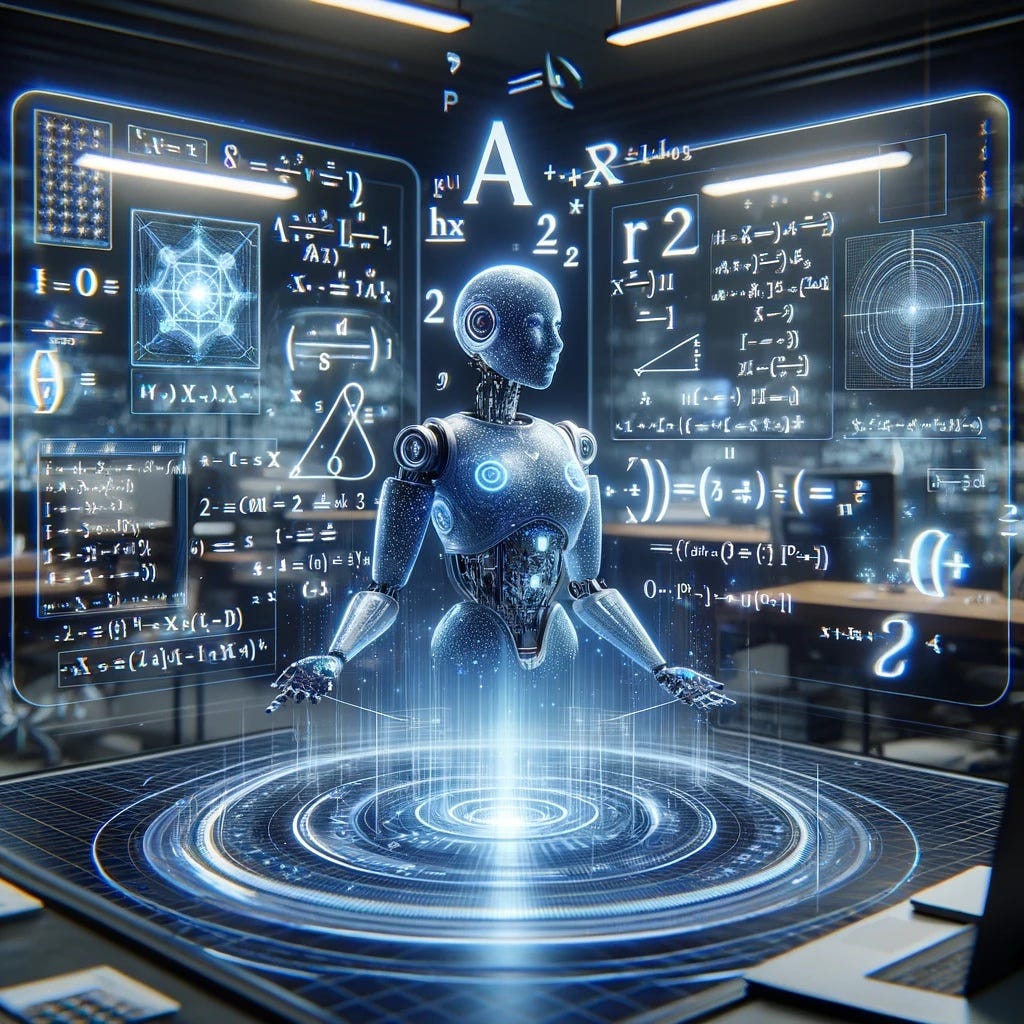
In May 2026, an internal OpenAI reasoning model disproved a central conjecture in discrete geometry — the Erdős unit distance problem — that had remained unsolved for 80 years. The proof was verified by external mathematicians including Sir Timothy Gowers, and it marked the first time an AI system autonomously solved a prominent open problem central to a subfield of mathematics. The announcement sent shockwaves through the mathematical community and reignited a debate that has been building for years: what does it mean to be a mathematician when AI can do the math?

The Milestone That Changed Everything
The Erdős unit distance problem, first posed by the legendary mathematician Paul Erdős in 1946, asks a deceptively simple question: given n points in the plane, what is the maximum number of pairs that can be exactly one unit apart? For decades, mathematicians believed the answer followed a specific bound conjectured by Erdős himself. OpenAI's general-purpose reasoning model — not a system specifically trained for mathematics — proved that conjecture wrong, constructing an infinite family of counterexamples using advanced tools from algebraic number theory.
This came on the heels of a remarkable February 2026 milestone called the First Proof challenge, where 11 distinguished mathematicians posed 10 research-level questions to the AI community. OpenAI's most advanced system solved five of them, with results described by mathematician Daniel Litt as "very likely bigger than the computer." Google DeepMind's Aletheia, derived from Gemini Deep Think, independently achieved publishable PhD-level results in arithmetic geometry. As frontier AI capabilities accelerate across domains, mathematics has become the proving ground for whether machines can genuinely reason.
From IMO Silver to Autonomous Research
The trajectory has been stunning. In 2024, DeepMind's AlphaProof and AlphaGeometry 2 achieved silver-medal standard at the International Mathematical Olympiad — solving four of six problems. By early 2025, AlphaGeometry 2 reached gold-medal level on geometry, solving 84% of IMO geometry problems from 2000 to 2024. By 2026, systems had leapfrogged from competition problems to genuine research. DeepMind's AlphaProof Nexus project, published in May 2026, demonstrated an AI agent capable of automatically formalizing and proving mathematical statements in the Lean proof assistant — including problems from the Erdős collection — with minimal human intervention.
The formalization breakthrough may be the most consequential. In February 2026, an AI called Gauss formalized a Fields Medal-winning proof about 24-dimensional sphere packing in just two weeks — a task that would have taken human experts months. The compute required for such reasoning tasks remains substantial, but the speed of progress has surprised even the optimists.
| Milestone | System | Year | Significance |
|---|---|---|---|
| IMO Silver Medal | AlphaProof + AlphaGeometry 2 | 2024 | First AI to solve IMO problems at medal level |
| Gold-Medal Geometry | AlphaGeometry 2 | 2025 | 84% success rate on IMO geometry problems |
| PhD-Level Research | Aletheia (Gemini Deep Think) | 2026 | Autonomous publishable results in arithmetic geometry |
| 24D Sphere Packing Formalization | Gauss | 2026 | Fields Medal-winning proof formalized in 2 weeks |
| Erdős Conjecture Disproof | OpenAI Reasoning Model | 2026 | First AI to independently solve a central open problem |
| First Proof Challenge | OpenAI + Aletheia | 2026 | 5 of 10 research questions solved autonomously |
The Philosophical Reckoning
The June 2026 IEEE Spectrum cover story captured the existential tension perfectly. Mathematicians are confronting questions that go to the heart of their discipline: If AI can produce a correct proof that no human can understand, is it still mathematics? Fields Medalist Akshay Venkatesh of the Institute for Advanced Study argues that mathematics is fundamentally about "bringing us to agreement" — that the process of understanding, not just the answer, is what gives the field meaning. Others take a more pragmatic view: a proof is a proof, regardless of its origin.
Terence Tao, the celebrated UCLA mathematician, envisions a future of "Big Mathematics" — large-scale, decentralized collaborations where AI handles the technical grunt work of formalization and verification while humans focus on creative conjecture and high-level strategy. Tao has pointed out that formal verification tools built for AI theorem proving could enable mathematicians to collaborate at unprecedented scale, with AI filtering out errors before they ever reach human reviewers.
Yang-Hui He of the London Institute for Mathematical Sciences painted a more provocative picture at the 2025 Heidelberg Laureate Forum, suggesting that human mathematicians could become "priests to oracles" — interpreters of AI-generated proofs that no human can fully trace.
The Risks: When Proofs Become Oracles
The risks are significant. If AI systems produce correct proofs that are too complex for humans to verify independently, mathematics could split into two tracks: human-scale mathematics that remains accessible and AI-scale mathematics that only machines can navigate. There is also the risk of over-reliance — if mathematicians outsource too much reasoning to AI, the intuitive understanding that drives creative breakthroughs could atrophy. Fields Medalist June Huh has warned that losing direct experience with mathematical understanding could impoverish the discipline over generations.
On a more immediate practical level, AI systems can and do produce plausible-sounding but incorrect proofs. The automated verification layer provided by proof assistants like Lean is essential — it ensures that even if an AI hallucinates a proof strategy, the final result is machine-checked. This verification layer is what makes AI theorem proving different from AI content generation in other domains.
The India Connection
India has a deep and proud mathematical tradition, from Srinivasa Ramanujan to Fields Medalists Manjul Bhargava and Akshay Venkatesh — both of Indian origin. In 2025, India's first privately funded mathematics research institute, the Lodha Mathematical Sciences Institute in Mumbai, was launched with Bhargava on its advisory council. The institute aims to create a world-class research environment for pure and applied mathematics in India.
For India's technology ecosystem, the AI-in-mathematics revolution presents both opportunity and challenge. As India invests billions in AI infrastructure, the ability to apply AI to mathematical research could accelerate breakthroughs in cryptography, optimization, and scientific computing — all areas where Indian institutions have strong capabilities. The Indian Institutes of Technology and the Indian Institute of Science have active programmes in formal verification and automated reasoning that could leverage these new AI tools. The IndiaAI Mission specifically identifies foundational AI research as a priority area, and mathematical reasoning is foundational to every AI system.
India's IT services industry, already generating $10-12 billion in AI services revenue, could apply AI-powered formal verification to improve software reliability for global clients — a natural extension of the quality assurance capabilities Indian firms have built over decades.
What Comes Next
The consensus among leading mathematicians is that AI will not replace mathematicians but transform the discipline in ways that are still unfolding. Within five years, AI-assisted proof assistants may become standard tools for every working mathematician, much as computer algebra systems like Mathematica are today. Within a decade, AI may contribute to solving one of the remaining Millennium Prize Problems — the seven most famous unsolved problems in mathematics, each carrying a $1 million prize.
The deeper question — what mathematics is for, when machines can do it — will be answered not by technology but by mathematicians themselves. As Jeremy Avigad of Carnegie Mellon puts it: "Sometimes, understanding just strikes you as being very beautiful. That feeling of accomplishment — that's something AI cannot take away."
FAQ
What did the OpenAI model actually prove?
It disproved the Erdős unit distance conjecture, a central problem in combinatorial geometry that had been open since 1946. The conjecture concerned the maximum number of unit-distance pairs among n points in the plane.
Can AI really do original mathematical research now?
Yes — the OpenAI disproof and Aletheia's PhD-level results demonstrate AI systems can produce original, publishable mathematical research that has been verified by human experts. This is distinct from solving competition problems.
What is a proof assistant like Lean?
Lean is a formal proof assistant that lets mathematicians write proofs in a precise, machine-checkable language. AI systems are increasingly used to autoformalize informal mathematical statements into Lean and to search for proofs automatically.
How does this affect mathematics education in India?
Indian institutions like IISc and IITs have active formal verification programmes. AI theorem-proving tools could become standard in advanced mathematics curricula, complementing traditional proof-writing skills.
Could AI solve the Riemann Hypothesis?
While no current AI system can solve the Riemann Hypothesis (one of the seven Millennium Prize Problems), the pace of progress suggests AI-assisted approaches could contribute meaningful partial results within the decade.
Sources
- IEEE Spectrum — AI in Mathematics Is Forcing Big Questions (June 2026)
- OpenAI — An OpenAI Model Has Disproved a Central Conjecture in Discrete Geometry (May 2026)
- Google DeepMind — Accelerating Mathematical and Scientific Discovery with Gemini Deep Think
- Quanta Magazine — The AI Revolution in Math Has Arrived (April 2026)
- arXiv — Advancing Mathematics Research with AI-Driven Formal Proof Search (AlphaProof Nexus)
- The Indian Express — India's First Private Maths Research Institute Launches in Mumbai