For years, the dominant narrative around artificial intelligence has centred on one bottleneck: Nvidia's graphics processing units, the scarce chips that train and run large language models. Companies hoard them, governments subsidise their production, and markets hang on CEO Jensen Huang's every word for supply signals. But a thematic report from Shriram Asset Management Company, corroborated by Goldman Sachs Research and the International Energy Agency, argues that the real binding constraint on the AI build-out is not silicon — it is electricity.
The report positions India not as a developer of frontier AI models, but as a supplier of the physical infrastructure every AI data centre depends on: power generation, transmission lines, transformers, cables, switchgear, cooling systems, and diesel gensets. For Indian investors with no listed frontier AI labs or hyperscale cloud providers to buy, this 'picks and shovels' thesis offers a path into the AI boom without betting on which AI company wins.
Why Power, Not GPUs, Is the Binding Constraint
Amazon CEO Andy Jassy put it bluntly earlier this year: "Our single biggest constraint is power." The Shriram report, citing the IEA, notes that global data centre electricity demand is projected to nearly double from approximately 415 TWh in 2024 to 945 TWh by 2030. A single AI-grade data centre operating at 1 GW capacity consumes as much electricity as roughly 750,000 homes — and can cost $20-50 billion when fully equipped with compute hardware. The wide range reflects whether the figure includes GPU hardware — Google's $15 billion Visakhapatnam project is likely construction and basic infrastructure, while Shriram's $20-50 billion estimate includes the full compute stack.
Ropes & Gray, in its 2026 analysis of data centre investment trends, reached a similar conclusion: "Power availability — not capital — is the primary constraint on the pace of data centre development." In the near term, Goldman Sachs notes that GPU supply remains a bottleneck while new fabs come online over the next 12-18 months. But over the 5-10 year horizon that infrastructure investors care about, power availability emerges as the harder constraint.
Goldman Sachs estimates that the four largest hyperscalers — Meta, Microsoft, Amazon, and Alphabet — have already committed approximately $1.08 trillion in cumulative AI capex between 2021 and 2025. Their collective spending in 2026 alone is projected at roughly $725 billion, a 77% increase year-over-year. Over the longer horizon, Goldman's 'Tracking Trillions' report puts the four-company cumulative AI capex at $5.3 trillion by 2030, with a broader AI infrastructure estimate of $7.6 trillion through 2031.
GPUs still account for roughly 60-67% of an AI data centre's capital cost, meaning the non-compute portion — power infrastructure, cooling, land, construction, networking — represents a multi-trillion-dollar addressable market. It is this portion that Indian companies are best positioned to serve.
The 'Picks and Shovels' Thesis for India
The Shriram report's distinctive analytical contribution is to frame India's AI opportunity not through its well-documented talent pool or IT services sector, but through a physical-infrastructure-as-investment-vehicle lens. India has no listed frontier AI model developers — no company comparable to OpenAI, Anthropic, or Google DeepMind — and no listed hyperscale cloud provider at the scale of AWS, Azure, or GCP. The heavyweights of Indian technology — TCS, Infosys, Wipro, and HCL — are IT services companies; they build and maintain software but do not operate the foundational AI infrastructure powering the global boom.
What India does have is a deep and established power ecosystem: generation companies including NTPC, Adani Power, and Tata Power; transmission operators such as Power Grid Corporation; EPC contractors like Larsen & Toubro and Siemens India; transformer and switchgear manufacturers including CG Power and Industrial Solutions and ABB India; cable makers such as Polycab, KEI Industries, and Havells India; and cooling system providers. The Shriram report maintains an overweight position on every node of this ecosystem.
The thesis is that physical infrastructure demand is platform-agnostic. It does not matter whether OpenAI, Google, Meta, or a Chinese lab wins the frontier model race — every scenario requires more data centres, and every data centre requires power, transmission, cooling, and electrical equipment. Indian power infrastructure companies collect the same toll regardless of which AI company captures the revenue. This structural insulation from AI business model uncertainty means India's power ecosystem benefits irrespective of whether AI revenue eventually justifies the current spending.
India's Data Centre Boom Is Already Underway
The evidence for this thesis is not theoretical. In June 2026, Meta announced a partnership with Reliance Industries to develop an AI-enabled data centre in Jamnagar, Gujarat, starting at 168 MW with potential expansion to 1 GW. Meta separately contracted 1 GW of clean energy in India to power its operations. The Jamnagar facility follows Reliance's broader $17 billion-plus investment in a Visakhapatnam data centre cluster that will host Google's 1 GW AI data centre — a project reported at approximately $15 billion.
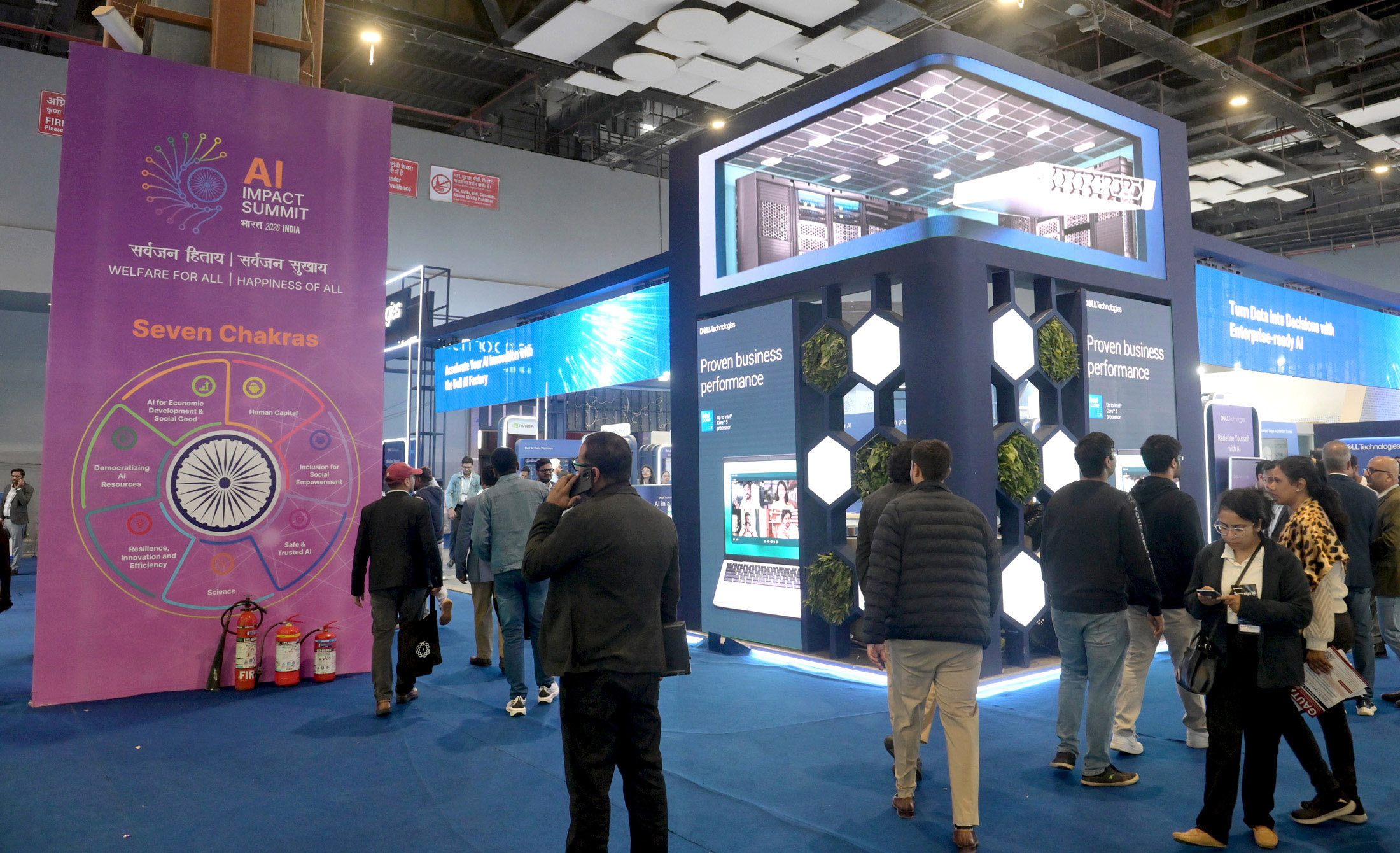
AdaniConneX, a joint venture between Adani Enterprises and EdgeConneX, is targeting 1 GW of data centre capacity across India, with operational facilities in Chennai, Hyderabad, Noida, Bengaluru, and Pune. The government has granted 'Infrastructure Status' to data centres, unlocking cheaper financing and tax holidays through 2047. This aligns with the government's broader push to establish Hyderabad as a dedicated AI and semiconductor hub. The India AI Impact Summit in February 2026 at Bharat Mandapam, New Delhi, included dedicated sessions on data centre power requirements, grid resilience, and cooling innovation.
Deloitte projects India's data centre capacity expanding from 1.7-2.0 GW in 2026 to 8-10 GW by 2030. The Indian data centre market was valued at approximately $10 billion in 2025 and is projected to exceed $22 billion by 2030. Yet a critical question remains: can India's transmission grid handle the projected expansion? In FY2025, the government fell 42% short of its transmission line installation targets — a gap that could become the next bottleneck after power generation itself.
While India lacks a frontier AI lab today, initiatives such as the government's push for semiconductor self-reliance signal a longer-term ambition to build deeper technology capabilities. For now, however, the immediate and tangible opportunity remains physical infrastructure. India's operational data centre capacity currently stands at approximately 1.2—1.5 GW, meaning Deloitte's 8—10 GW projection represents a 5—8× expansion over the next four years.
The Unit Economics Question
The Shriram report is notably measured about one aspect of the AI investment thesis: returns. The AI industry currently generates an estimated $50-150 billion in annual revenue — a wide range reflecting the absence of consensus data. To earn a 10% return on cumulative capital deployed, the industry would need $600-650 billion in additional annual revenue. This gap is not evidence of an imminent bubble bursting, the report argues, but a genuine question about unit economics that will play out over the next decade.
This framing is more nuanced than typical 'AI bubble' headlines. If AI fails to generate sufficient returns, hyperscalers will eventually slow their capex, reducing the pace of data centre construction. But the power infrastructure thesis is partially insulated from this risk: India's power ecosystem supplies the broader economy, not just data centres. Companies like NTPC, Power Grid, and Polycab serve industrial, residential, and commercial demand. AI-driven data centre growth is incremental demand on an existing system, not the sole driver.
Moreover, this supply-chain framework means Indian power infrastructure companies benefit regardless of whether AI revenue grows to justify current spending. The physical infrastructure is built upfront; the return-on-capital question is asked later — and asked of the hyperscalers, not the equipment suppliers. As long as the hyperscalers continue spending, Indian suppliers collect the revenue.
What This Means for Indian Investors
The Shriram report's overweight positioning on the power sector spans generation, transmission, EPC, power financiers, diesel genset manufacturers, transformers, switchgear, cables, and cooling systems. This is not a speculative bet on a single technology — it is a structural allocation to every layer of the physical infrastructure stack that AI data centres depend on.
For Indian investors, the report offers a clear analytical framework: frontier AI development may happen in Silicon Valley, Seattle, Beijing, and London, but the factories that build the infrastructure can be in India. The country has no homegrown Nvidia and no homegrown OpenAI — but it does have NTPC, Power Grid Corporation, Larsen & Toubro, Polycab, and KEI Industries. The 'AI trade' available on the BSE is not about AI models or GPUs. It is about transformers, transmission towers, and terawatt-hours.
Sarojini Meruvu is a business and technology journalist covering the intersection of AI, infrastructure, and investment in India. Views expressed are her own.
For related context, see India IT Industry Generates $10-12 Billion in AI Services Revenue, Reveals Nasscom and India's Institutional Real Estate Investments Jump 23% to $4.3 Billion in H1 2026 as Domestic Capital Hits Record 64% Share.
For related context, see Countries Are Competing to Build the Most Powerful Mass Surveillance Systems, Report Warns.
Sources
- Business Today: AI's biggest bottleneck isn't Nvidia
- ANI: Power sector to be India's biggest AI opportunity: Report
- Goldman Sachs: Private Markets Expected to Have a Growing Role in Data Center Financing
- Goldman Sachs: Tracking Trillions — The Assumptions Shaping the Scale of the AI Build-Out
- International Energy Agency: Energy and AI — Energy demand from AI
- Ropes & Gray: Data Center Investment in 2026
- Meta Newsroom: Meta Partners With Reliance on AI-Enabled Data Center in India
- The New Indian Express: India's data centre boom
- The Economist: India is in the midst of a data-centre investment boom
- Press Information Bureau: India AI Impact Summit 2026
- Ziro Market: AI Data Centers 2026 | The $690B Power Crunch
- DC&T Global: Future of Data Centers in 2026: AI, Energy & Cooling Innovations