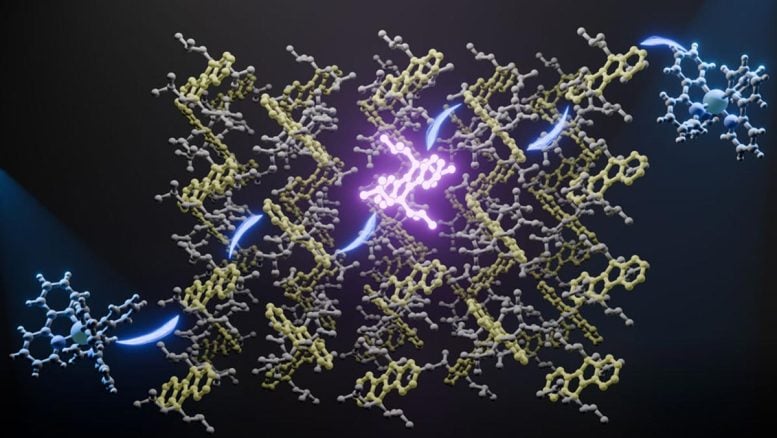
Researchers at Kyushu University in Japan have developed a solid-state molecular material that can convert ordinary visible sunlight into high-energy ultraviolet (UV) light, a breakthrough that could transform how solar energy is used across industries ranging from air purification to 3D printing.
The study, published in Nature Communications on June 23, 2026, describes a material based on an organic semiconductor called dihydroindenoindenedene (DHI) that achieves a visible-to-UV conversion efficiency of 1.9% under natural outdoor sunlight. While that figure may seem modest, it represents the first time a solid-state material has achieved photon upconversion at sunlight intensity without requiring lasers or concentrated light sources.
How Photon Upconversion Works
The process relies on a quantum phenomenon called triplet-triplet annihilation (TTA) photo upconversion. In essence, the material absorbs two low-energy visible light photons and combines their energy to emit a single higher-energy ultraviolet photon. A donor molecule captures visible light and enters a high-energy triplet state, transferring that energy to an acceptor molecule. When two such excited states collide, they annihilate and release all their combined energy as UV light.
"What we do here is add together the energy from two visible light photons to make one ultraviolet photon. It is a fascinating process called photo upconversion," explains Yoichi Sasaki, Associate Professor at Kyushu University Faculty of Engineering and the study corresponding author.
While TTA upconversion has been demonstrated in liquid systems before, achieving it in solid materials has proven far more difficult. Molecules in solids pack tightly together, causing their electron clouds to overlap and quench the excited states before they can interact. The Kyushu team solved this by attaching alkyl chains to the sp3 carbon atoms of DHI molecules, creating precisely controlled gaps that keep molecules close enough for energy transfer while preventing unwanted electronic interactions.
Why This Discovery Matters
UV light accounts for only about 6% of the sunlight reaching Earth surface, yet it is indispensable for applications including air purification, resin curing in 3D printing, gel hardening for dental fillings and nail art, and driving chemical reactions. Currently, these processes depend on UV lamps that consume electricity and require specialised equipment.
"This means roughly two UV photons are produced for every hundred visible-light photons absorbed," Sasaki adds. "It may sound low, but it runs on natural sunlight alone. Most solid-state materials cannot realize this even at much higher light intensity."
The material also achieves a solid-state fluorescence quantum yield of more than 60%, meaning it efficiently converts absorbed light into usable emissions rather than losing energy as heat. The team has filed a patent application, and the material offers advantages for real-world use including straightforward synthesis using low-cost starting materials. Potential applications span solar-driven photocatalysis, indoor air purification systems that break down pollutants using sunlight, and low-intensity UV-curing for 3D printing.
The development of this sunlight-harvesting material parallels other recent advances in understanding how light interacts with matter, including JWST discoveries that probe atmospheric properties of distant worlds using spectroscopy techniques that depend on similar photon interaction principles.
A Decade-Long Journey and a Retirement Gift
The breakthrough marks the culmination of more than 14 years of research. In 2012, Nobuo Kimizuka, now Professor Emeritus at Kyushu University Research Center for Negative Emissions Technologies, pioneered research into photon upconversion via triplet energy migration in self-assemblies. Despite steady progress with liquid and gel systems, the solid-state version remained stubbornly out of reach for over a decade.
The key breakthrough came in May 2024, less than a year before Kimizuka retirement. Graduate students Naoyuki Harada, Hayato Shoyama, Nutnicha Boonmong, along with then-Assistant Professor Kiichi Mizukami, worked intensively alongside Sasaki to compress years of work into a final paper. They submitted the draft to Kimizuka just 11 days before he left the lab.
"This discovery is the culmination of over 14 years of our research and marks a major milestone in photon-upconversion and molecular self-assembly research," Kimizuka says.
The ability to control molecular assembly at such fine scales has implications beyond this single material. Similar molecular engineering approaches could be applied to other problems in energy conversion and atmospheric science, where understanding how molecules interact with light at the quantum level informs everything from solar cell design to climate modelling.
Future Applications and Commercial Potential
The Kyushu team sees a wide range of practical applications for the material. Solar-driven photocatalysis could use UV generated from sunlight to break down environmental pollutants or drive chemical manufacturing processes. Indoor air purification systems could operate passively using window light rather than powered UV lamps. Low-intensity 3D printing could benefit from sunlight-based resin curing, reducing energy costs and simplifying equipment.
Since the material is solid-state and non-toxic, it avoids the evaporation and disposal issues associated with liquid-based upconversion systems that rely on organic solvents. The straightforward synthesis and low-cost starting materials make large-scale production feasible.
Frequently Asked Questions
What is photon upconversion?
Photon upconversion is a process where two low-energy photons combine to produce one higher-energy photon. In this case, two visible light photons are converted into one ultraviolet photon.
How efficient is the new material?
The material achieves a 1.9% visible-to-UV conversion efficiency under natural sunlight, with a solid-state fluorescence quantum yield above 60%.
Does it work with ordinary sunlight?
Yes, the material operates under normal outdoor sunlight intensity, without any need for lasers, concentrators, or specialised light sources.
What can this technology be used for?
Potential applications include solar-driven air purification, UV curing for 3D printing, dental fillings, nail art, photocatalysis for chemical manufacturing, and any process that currently requires UV lamps.
When will this technology be commercially available?
The team has filed a patent application and the material uses low-cost starting materials with straightforward synthesis, but commercial products are likely several years away as the technology undergoes further development and scaling.
How does this compare to existing UV technologies?
Current UV generation relies on electrically powered UV lamps. This material could potentially replace those lamps with passive solar-powered UV generation, reducing energy consumption and equipment complexity.
Sources
- Nature Communications: Sterically protected pi-electron systems for efficient solid-state photon upconversion (2026)
- Kyushu University Research Results: Harvesting UV Light from Sunlight Just Got Solid
- Phys.org: Solid-state material turns visible light into high-energy UV at sunlight intensity
- SciTechDaily: Scientists Turn Ordinary Sunlight Into UV Light in Major Energy Breakthrough