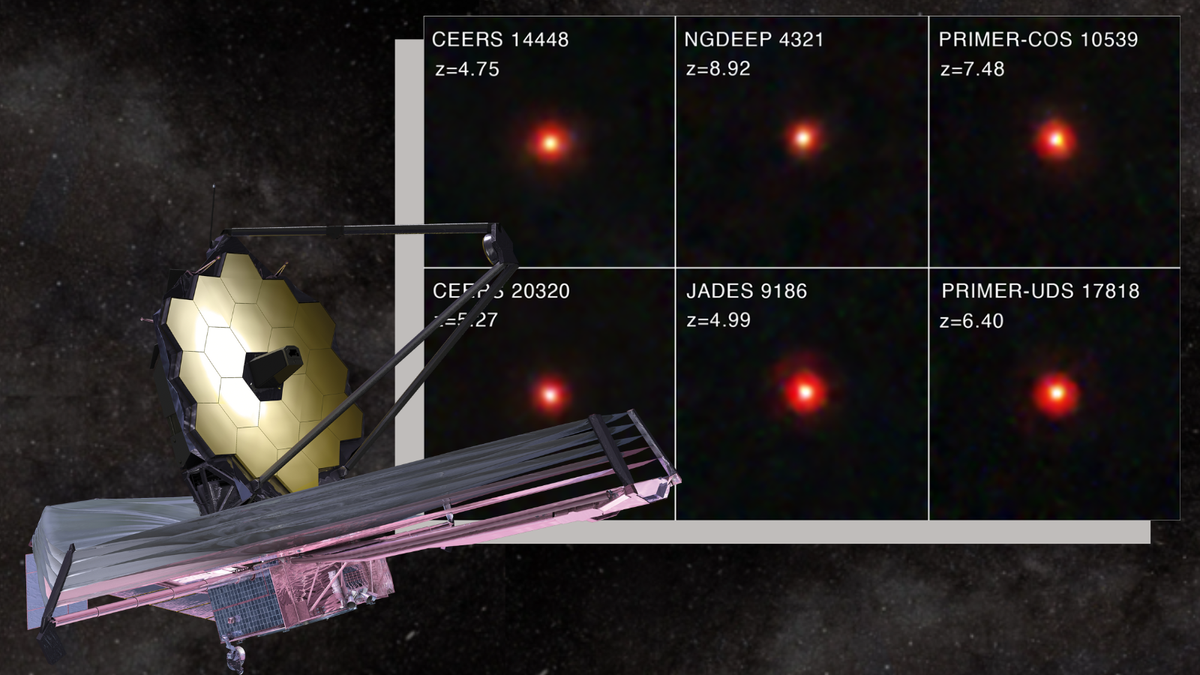
The James Webb Space Telescope has captured the deepest spectrum yet of a "little red dot" — and the data show that the most controversial objects in early-universe astronomy are likely not what most observers assumed. NASA's Goddard Space Flight Center team reported on June 10, 2026 that a particular little red dot, GLIMPSE-17775, has 40+ spectral lines consistent with a single picture: a black hole wrapped in a thick, hot cocoon of hydrogen and helium gas. The finding is the strongest evidence yet for the "black hole star" hypothesis first proposed to explain the dots that Webb started finding in 2022.
What Are Little Red Dots?
Little red dots (LRDs) are compact, very red astronomical objects that turn up in large numbers in Webb's deep-field surveys of the universe at 600 million to 1.5 billion years after the Big Bang. They are unusually abundant — and they appear to vanish by the time the universe is 2 billion years old. The pattern broke the standard model of early galaxy formation: there shouldn't be that many galaxies that bright that small, and there is no clear evolutionary path from them to the galaxies we see at later times.
| Object | GLIMPSE-17775 (behind galaxy cluster Abell S1063) |
| First discovered | JWST, summer 2022 |
| Spectral lines | 40+ independently support the "black hole star" model |
| Epoch observed | ~600M–1.5B years after the Big Bang |
| Competing hypothesis | Baby galaxies under construction |
| Key authors | Vasily Kokorev (UT Austin) et al., NASA + ESA + CSA team |
The Black Hole Star Idea
The "black hole star" model proposes that LRDs are supermassive black holes growing rapidly inside dense cocoons of hot gas. The cocoon glows in the optical and near-infrared, but the central engine is far more energetic than a young stellar population. This is one possible reason LRDs are so red: dust and gas absorb the higher-energy photons and re-emit them at longer wavelengths. The latest Webb spectrum of GLIMPSE-17775 shows broad hydrogen and helium emission lines characteristic of an accreting black hole, plus narrow forbidden lines from the surrounding gas — exactly the signature the model predicts.
Why It Matters
Webb is now showing that the universe's first black holes were already massive when the cosmos was less than a billion years old. That, in turn, has implications for how the seeds of those black holes formed — direct collapse of primordial gas clouds, mergers of dense stellar remnants, or something else. The Kokorev team's result also dovetails with a separate Webb finding (QSO1) showing a black hole that appears to have formed before its host galaxy, a scenario that is hard to explain in standard cosmological models. If LRDs are confirmed as black hole stars, they provide a missing link between the earliest black holes and the supermassive ones we see at the centres of mature galaxies today.
What the Result Cannot Tell Us
- It cannot tell us how the seeds formed — the spectrum does not preserve formation history.
- It cannot tell us how common black hole stars really are — one object is not a population statistic.
- It does not rule out the alternative "compact galaxy" model for other LRDs — different dots may have different origins.
- It does not explain the disappearance of LRDs by 2 billion years post-Big Bang — that is still a separate puzzle.
What This Means for India
India's space astronomy program is small but real. ISRO's AstroSat, launched in 2015, was the first Indian multi-wavelength space observatory and continues to operate. India's proposed participation in next-generation observatories — including follow-up missions to Webb and the proposed National Large Solar Telescope and an X-ray polarimetry mission — would give Indian researchers direct access to early-universe surveys. Indian groups at IUCAA (Pune), IIA (Bengaluru), and TIFR have co-authored multiple Webb papers and are likely to be involved in the next round of LRD follow-up. For an Indian student in astrophysics, the field is now demonstrably one of the most productive in observational cosmology.
Sources: NASA Science (Goddard, June 10 2026), ESA Webb press release, Space.com, Universe Today
See also: Scientists Discover 1,121 New Marine Species in a Single Yea · NASA ISS Air Leak Worsens: Crew Moved to Safe Haven, Risky R
Sources
- Nature — nature.com
- NASA — nasa.gov
- Voxlogue editorial research