A Lost Leaf from One of History's Most Important Manuscripts
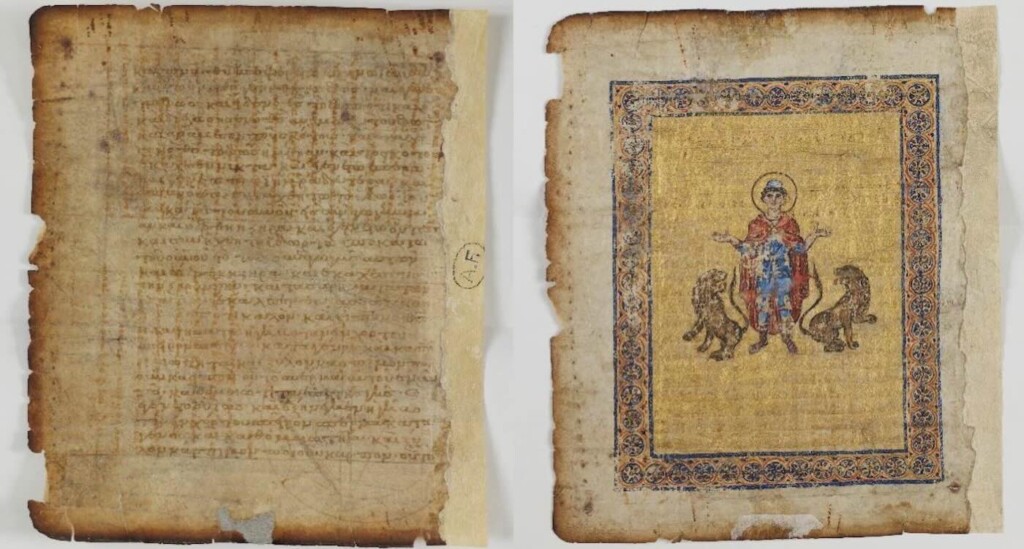
A long-lost leaf from the Archimedes Palimpsest, one of the world's most important ancient manuscripts, has been rediscovered at the Musee des Beaux-Arts in Blois, France. The page, identified as page 123, contains part of Archimedes' mathematical treatise On the Sphere and the Cylinder and had been missing for decades, known only through photographs taken in 1906.
The discovery was made by Victor Gysembergh of the CNRS Centre Leon Robin at Sorbonne University, who recognized the leaf by matching it against photographs taken by Danish scholar Johan Ludvig Heiberg in 1906. The identification was confirmed through detailed comparison of the visible text, geometric diagrams, and the manuscript's distinctive physical characteristics. The finding was published in the journal Zeitschrift fur Papyrologie und Epigraphik.
The Archimedes Palimpsest: A Thousand-Year Journey
The Archimedes Palimpsest is a 10th-century Greek manuscript containing works by Archimedes of Syracuse, the greatest mathematician of antiquity. In the Middle Ages, the original text was erased so the parchment could be reused for Christian prayer texts — a common practice due to the high cost of animal-skin materials. The manuscript traveled from Jerusalem to Constantinople before Heiberg photographed it in 1906. It then entered a private French collection and was auctioned in 1996 to a private collector. It is currently housed at the Walters Art Museum in Baltimore, where multispectral imaging in the early 2000s revealed the underlying Archimedes texts along with unknown ancient literary and philosophical fragments.
The Rediscovered Page: What It Contains
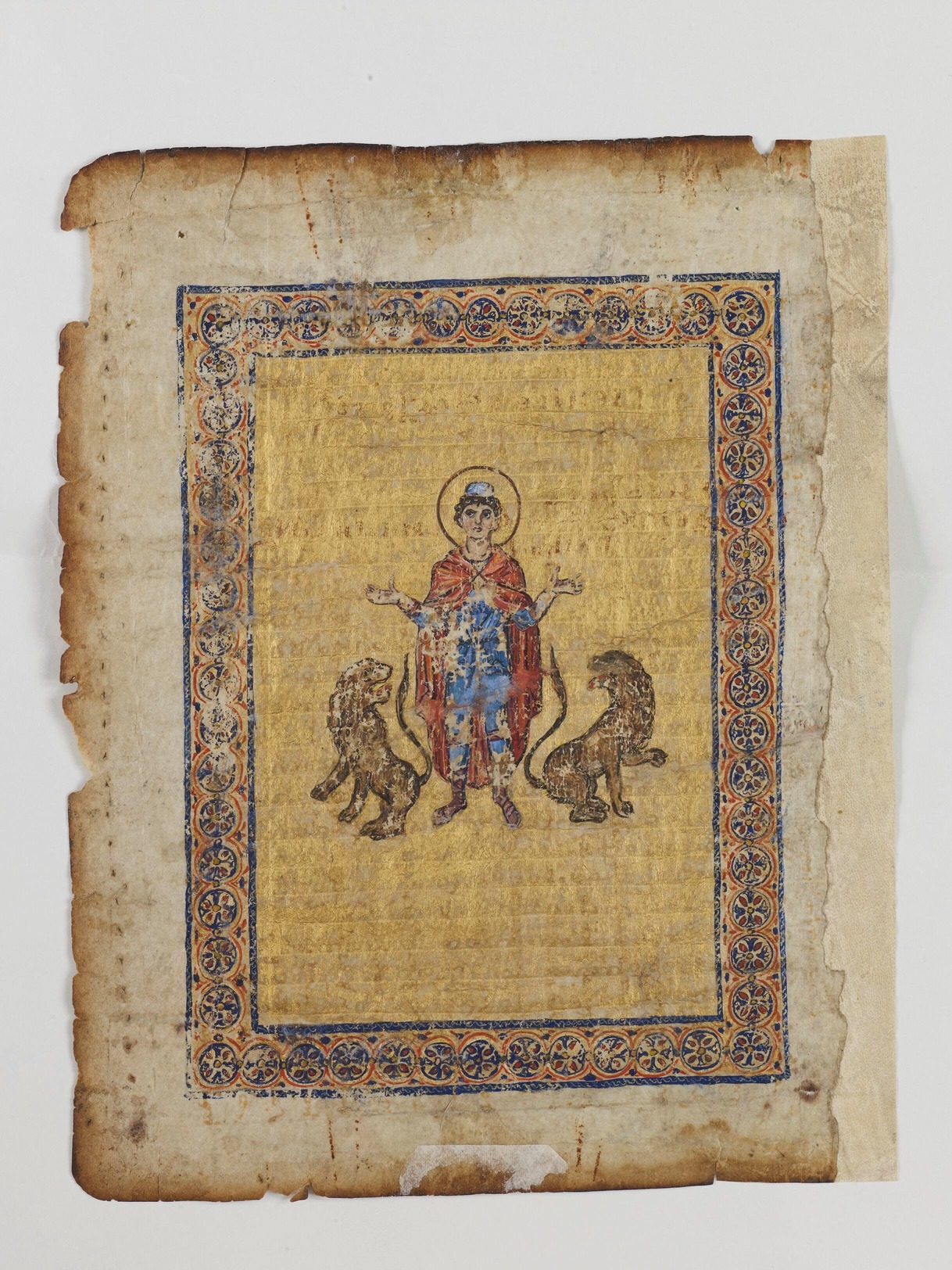
The newly identified leaf contains Propositions 39 through 41 from Book I of On the Sphere and the Cylinder, one of Archimedes' most influential works. The front of the page shows prayer text laid partly over geometric diagrams, with much of the underlying text still readable. The reverse side presents a unique challenge: it is covered by a 20th-century illumination of the Prophet Daniel with two lions, making the ancient writing beneath inaccessible through conventional methods.
Three leaves recorded in Heiberg's 1906 photographs vanished before reaching the manuscript's current owner. This discovery accounts for one of them. Researchers are hopeful that modern techniques will also locate the remaining two missing leaves.
| Aspect | Detail |
|---|---|
| Manuscript | Archimedes Palimpsest (10th century) |
| Missing Leaf | Page 123 |
| Content | On the Sphere and the Cylinder, Book I, Props 39-41 |
| Found At | Musee des Beaux-Arts, Blois, France |
| Identified By | Victor Gysembergh, CNRS/Sorbonne University |
| Identification Method | Matched against Heiberg's 1906 photographs |
| Challenge | Reverse covered by 20th-century illumination |
| Publication | Zeitschrift fur Papyrologie und Epigraphik, March 2026 |
Future Research: Unlocking Hidden Text
First imaging campaigns are expected within a year, pending authorizations from the museum and manuscript owner. Researchers plan to combine multispectral imaging with synchrotron X-ray fluorescence analysis to penetrate the 20th-century illumination and read the Archimedes text beneath. The discovery has also sparked renewed interest in re-examining the entire Archimedes Palimpsest with more powerful tools than were available in the early 2000s, potentially unlocking pages that remained illegible during the first campaign.
India Angle: Ancient Mathematical Heritage
The rediscovery resonates deeply in India, which has its own rich mathematical heritage stretching back to the ancient Indus Valley civilization, the Vedas, and the Kerala school of mathematics. Indian mathematicians like Aryabhata, Brahmagupta, and Ramanujan made foundational contributions to number theory, algebra, and trigonometry. Indian institutions like the Indian Statistical Institute and the Tata Institute of Fundamental Research maintain world-class traditions in pure mathematics. The preservation and recovery of ancient mathematical texts is a shared global endeavor, and Indian scholars have contributed to palimpsest research through collaborations with European institutions.
For related Voxlogue context, read World First: Lab-Grown Oesophagus Successfully Implanted in Pigs — Hope for Children Born Without Food Pipe, and JWST Reveals Alien Planet Where Dawn and Dusk Have Completely Different Weather.