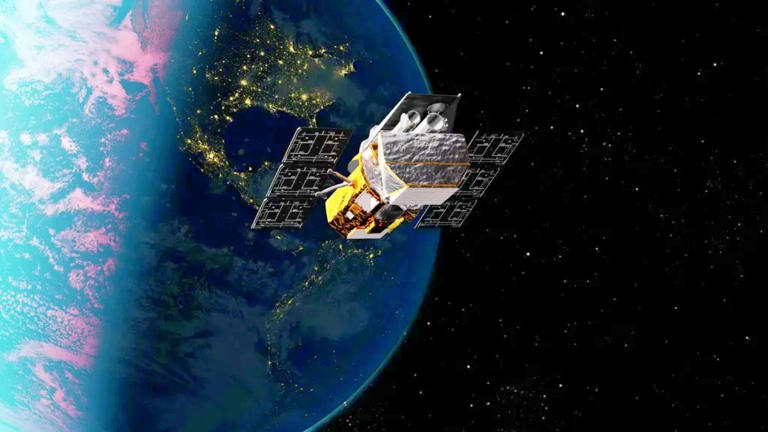
A Space Telescope in Peril
NASA's Neil Gehrels Swift Observatory — a space telescope that has revolutionised our understanding of gamma-ray bursts and high-energy cosmic phenomena — is falling to Earth, and the agency is racing to launch a daring rescue mission. Swift, launched in November 2004, has operated far beyond its original two-year design life, but orbital decay is now accelerating, and NASA estimates the telescope could re-enter Earth's atmosphere within the next 12-18 months without intervention.
The planned rescue, dubbed the "Swift Boost Mission," would involve a spacecraft rendezvousing with the observatory and firing thrusters to raise its orbit, potentially extending its operational life by another 5-10 years. It would be one of the most ambitious in-space servicing missions ever attempted for an uncrewed scientific observatory.
Swift's Legacy: 22 Years of Discovery
Since its launch, Swift has detected and localised over 1,500 gamma-ray bursts — the most powerful explosions in the universe, typically associated with the collapse of massive stars or the merger of neutron stars. Its rapid-response capabilities allow it to autonomously slew to new bursts within minutes, providing multi-wavelength follow-up observations across gamma-ray, X-ray, ultraviolet, and optical wavelengths.
Beyond gamma-ray bursts, Swift has contributed to an extraordinary range of astrophysics: studying tidal disruption events when stars are torn apart by black holes, monitoring active galactic nuclei, observing supernova shock breakouts, and providing critical follow-up for gravitational wave detections. Its data has generated over 7,000 peer-reviewed publications.
Why Swift Is Falling Faster Than Expected
Swift orbits at approximately 600 kilometres altitude in a low-Earth orbit. Atmospheric drag at this altitude varies with solar activity — increased solar ultraviolet radiation heats and expands the upper atmosphere, increasing drag on satellites. The current solar cycle has been more active than predicted, causing Swift's orbital decay rate to accelerate beyond previous projections.
The telescope has no propulsion system of its own — it relies on reaction wheels for attitude control and magnetic torquers for momentum management. Without a boost, its orbit will continue to decay until atmospheric friction causes it to break apart, with most debris burning up in the atmosphere but some fragments potentially reaching the surface.
The Rescue Plan
NASA's Swift Boost Mission concept involves launching a specialised servicing spacecraft that would rendezvous with Swift, match its orbit, and attach to the telescope's launch vehicle adapter ring — a standardised interface left over from its 2004 Delta II launch. The servicing craft would then fire its thrusters to raise Swift's orbit by 50-100 kilometres, significantly reducing atmospheric drag and extending the mission timeline.
The mission would leverage technologies developed for NASA's OSAM-1 (On-Orbit Servicing, Assembly, and Manufacturing) programme, which demonstrated autonomous rendezvous and docking capabilities. However, adapting these systems for a science observatory that was never designed for servicing presents unique engineering challenges.
What's at Stake
Swift remains scientifically productive, with no major instrument degradation despite its age. Its Burst Alert Telescope (BAT), X-Ray Telescope (XRT), and Ultraviolet/Optical Telescope (UVOT) continue to operate within nominal parameters. Losing Swift before a replacement is ready would leave a critical gap in high-energy astrophysics capabilities — similar to the gap created when the Compton Gamma Ray Observatory was deorbited in 2000 before its successors were operational.
Several next-generation gamma-ray missions, including the European Space Agency's THESEUS and NASA's proposed Gamow Explorer, are in development but not expected to launch before 2030. A successful rescue would ensure uninterrupted coverage of the transient high-energy sky for the rest of this decade.
For related Voxlogue context, read NASA's All-Male Artemis III Crew Sparks Outrage: Why No Women Were Selected for the Historic 2027 Mission, and World First: Lab-Grown Oesophagus Successfully Implanted in Pigs — Hope for Children Born Without Food Pipe.