India's Production-Linked Incentive (PLI) scheme has attracted actual investments exceeding Rs 2 lakh crore since its launch in 2020, generating incremental production and sales surpassing Rs 18.7 lakh crore and creating over 12.6 lakh jobs, according to the Economic Survey 2025-26. The scheme has emerged as one of India's most successful industrial policy interventions, transforming the country into a global electronics manufacturing hub.
PLI Scheme: Key Metrics
| Metric | Achievement |
|---|---|
| Actual investments (since 2020) | Rs 2+ lakh crore |
| Incremental production/sales | Rs 18.7+ lakh crore |
| Employment created | 12.6+ lakh jobs (direct + indirect) |
| Exports generated | Rs 8.2+ lakh crore |
| Cumulative incentives disbursed | Rs 23,946 crore |
| Approved applications | 806 across 14 sectors |
Electronics Manufacturing Boom
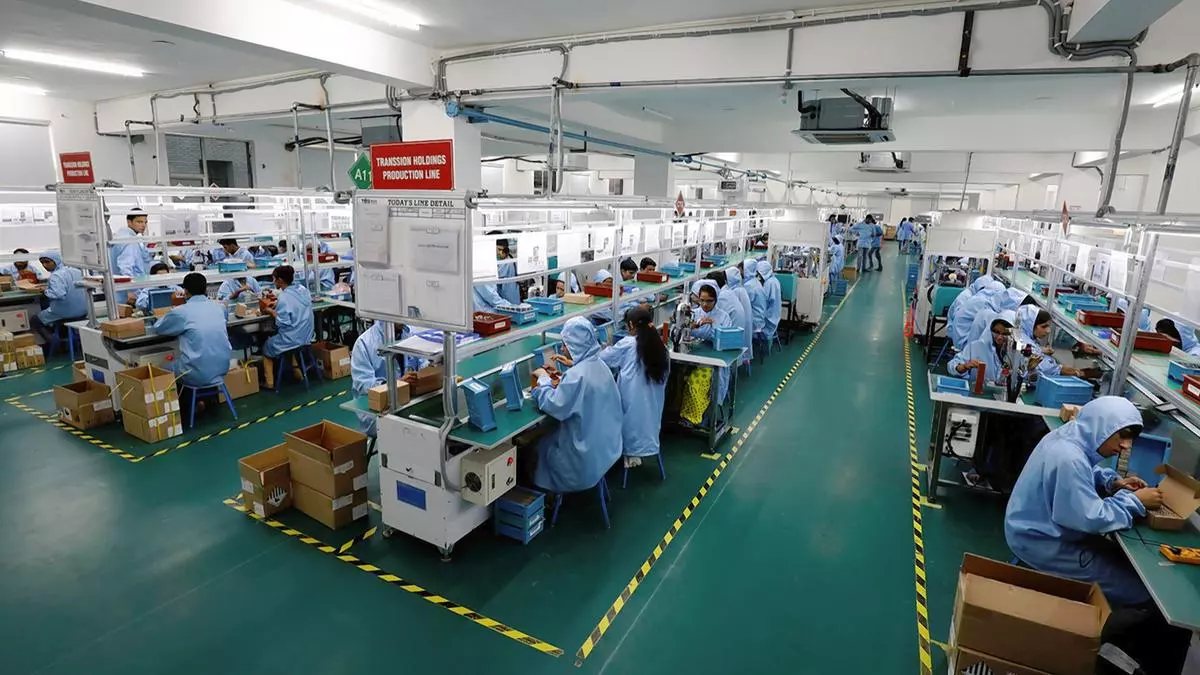
The electronics sector has been the standout performer under PLI. Electronic goods production rose from Rs 1.9 lakh crore in 2014-15 to Rs 11.3 lakh crore in 2024-25 — a six-fold increase. Exports during the period surged from Rs 0.38 lakh crore to Rs 3.3 lakh crore, an eight-fold increase. India's electronics exports crossed $47 billion in 2025, a 37 percent jump, with smartphone shipments accounting for nearly two-thirds of the total at roughly $30 billion.
Apple's iPhone exports from India crossed Rs 2 lakh crore in 2025, surging nearly 85 percent over 2024. India has become the world's second-largest mobile phone producer, with over 99 percent of phones sold domestically now made in India. Four semiconductor plants are coming into commercial production in 2026, which Union Minister Ashwini Vaishnaw says will sustain the momentum.
Budget 2026 Boost and PLI 2.0 Plans
Finance Minister Nirmala Sitharaman proposed a Rs 40,000-crore outlay for electronics manufacturing under PLI in FY 2026-27, nearly doubling the budgetary allocation in just two years. The government also plans to establish high-tech tool rooms at two locations to boost capital goods manufacturing. The original six-year tenure of the mobile phone PLI approaches its March 2026 deadline, and the government is reportedly weighing a fresh extension or a successor "PLI 2.0" to avoid risking the gains.
Beyond electronics, the pharmaceutical sector has demonstrated strong performance with sales crossing Rs 2.6 lakh crore under the scheme, including exports worth Rs 1.7 lakh crore. Other sectors showing notable progress include specialty steel (Rs 6,322 crore), white goods (Rs 6,238 crore), and medical devices (Rs 3,420 crore).
Why It Matters for India: The PLI scheme has fundamentally reshaped India's manufacturing landscape, reducing import dependence and creating millions of jobs. Its success has made India a credible alternative to China in global electronics supply chains. The extension debate — whether to continue PLI beyond 2026 — will be one of the most consequential policy decisions for India's manufacturing future. For job seekers and investors, the PLI-driven sectors offer the most promising growth opportunities in the Indian economy.
For related Voxlogue context, read Indias PLI Scheme Attracts Rs 2 Lakh Crore Investment Creates 12.6 Lakh Jobs in Electronics Manufacturing, and India Exports Surge 18 Per Cent to $45.2 Billion in May: Engineering Goods Lead as Trade Deficit Widens to $28.21 Billion.