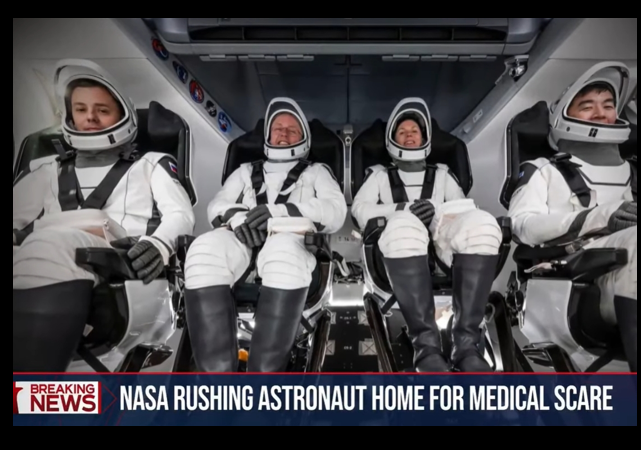
What is Happening on the ISS
A long-running air leak aboard the International Space Station has worsened significantly, NASA confirmed on June 8, 2026. The leak, tracked since 2019 in the Russian Zvezda service module PrK vestibule, has accelerated to a rate engineers describe as "a serious concern." Astronauts were temporarily moved into the US segment as a precaution while NASA and Roscosmos investigate newly identified suspected crack locations.
Timeline
| Date | Event |
|---|---|
| Sep 2019 | First detected: small leak in Zvezda module PrK vestibule |
| 2020-2021 | Multiple repair attempts using sealant patches; leak reduced but not eliminated |
| 2022-2024 | Leak stabilizes at ~0.2 kg/day; deemed manageable |
| Early 2026 | Leak rate accelerates; new crack suspected |
| Jun 8, 2026 | NASA confirms significant worsening; crew moved to safe haven |
Why This Matters
The ISS has been continuously occupied for over 25 years. The Zvezda module, launched in 2000, is one of the oldest pressurized modules. While NASA emphasizes the crew is not in immediate danger, the worsening leak highlights the challenges of maintaining a decades-old orbital laboratory where repairs require spacewalks and small cracks are extraordinarily difficult to locate.
India Gaganyaan Connection
Gaganyaan timeline: ISRO first crewed mission is targeted for 2027-2028. The ISS leak lessons around habitat integrity and crew safety protocols are being closely studied by ISRO engineers.
Indian astronaut training: Group Captains Prasanth Nair and Angad Pratap completed NASA training in 2025-26 for an ISS mission. The leak underscores the risks of long-duration spaceflight.
Bharatiya Antariksha Station: India plans for its own space station by 2035 will require mastering habitat maintenance and repair challenges the ISS is now confronting.
What is Next
NASA and Roscosmos are conducting detailed structural analysis to identify all active crack sites. A repair mission — likely involving a spacewalk with specialized sealant equipment — is planned but requires extensive ground testing. In the longer term, the incident strengthens the case for accelerating commercial space stations (Axiom, Blue Origin Orbital Reef) as eventual ISS replacements.
Sources: NASA, ScienceDaily, Space.com, ISRO, Roscosmos
Related: NASA Artemis III Crew Controversy | Webb Spots Black Hole Stars
See also: Scientists Discover 1,121 New Marine Species in a Single Yea · JUNO Neutrino Observatory Delivers First Results: Nature Cov
Sources
- Nature — nature.com
- NASA — nasa.gov
- Voxlogue editorial research