Engineers at Northwestern University have created printed artificial neurons that do not just imitate the brain — they can successfully communicate with it. In a landmark study published in the journal Nature Nanotechnology, the research team developed flexible, low-cost devices that generate electrical signals realistic enough to activate living brain cells, demonstrating a new level of compatibility between electronic devices and living neural systems.
How the Artificial Neurons Work
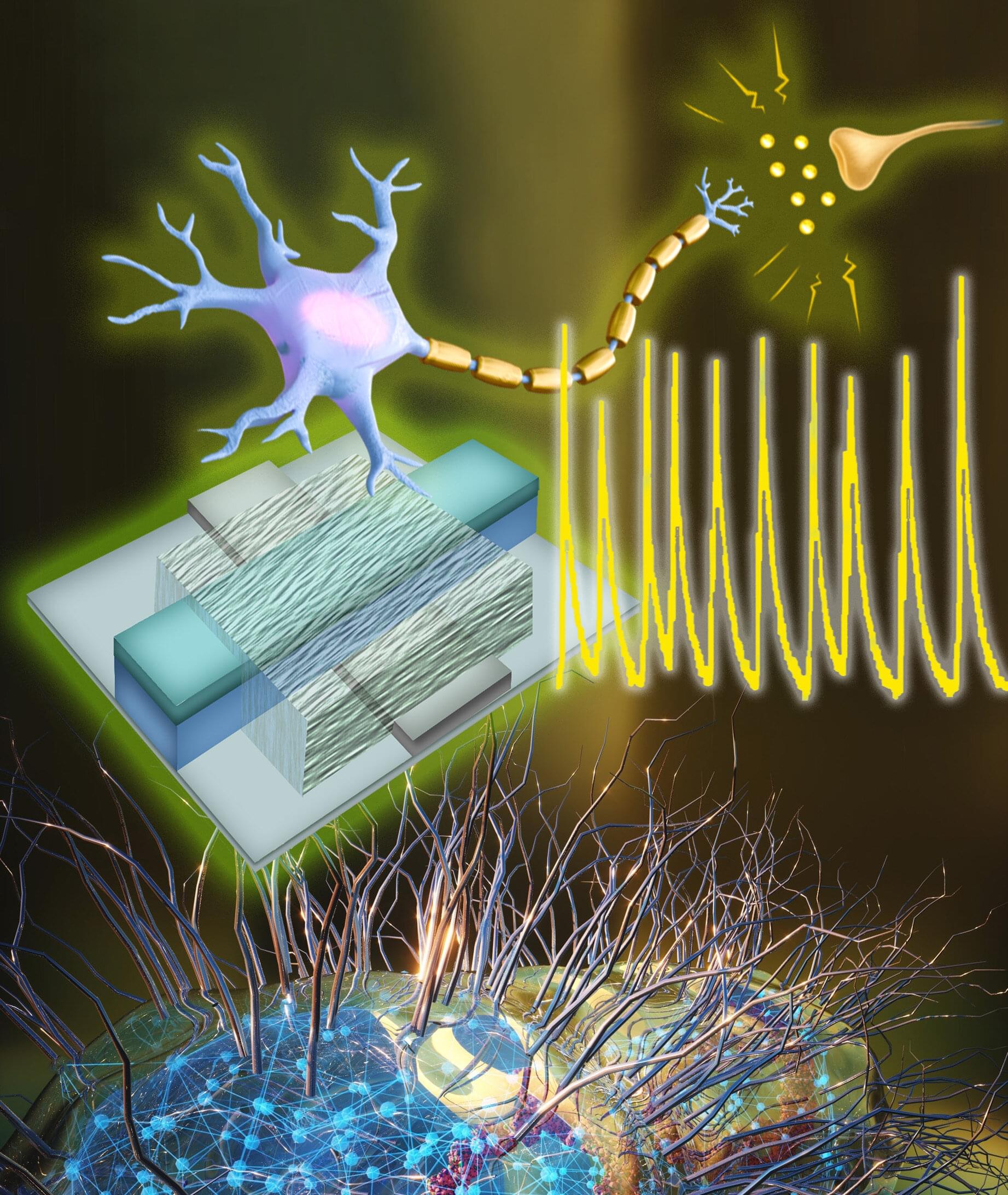
The artificial neurons were created using an aerosol jet printer that deposits specialised electronic inks onto a flexible polymer substrate. The ink contains nanoscale flakes of molybdenum disulfide — which acts as a semiconductor — and graphene, which serves as an electrical conductor. Unlike traditional silicon-based electronics that produce steady-state electrical currents, the printed neurons replicate the brain's natural firing mechanism using a phenomenon called "snap-back" behaviour. Electrical energy builds up gradually and is released instantaneously as a spike, closely mimicking how biological neurons fire. This enables the artificial neurons to generate multiple forms of complex signalling — including rhythmic firing and bursts of activity — within biologically relevant timescales that previous attempts had failed to achieve. "Other labs have tried to make artificial neurons with organic materials, and they spiked too slowly," said Mark Hersam, who co-led the research. "Or they used metal oxides, which are too fast. We are within a temporal range that was not previously demonstrated."
Testing on Living Brain Tissue
To evaluate whether the artificial neurons could truly interface with biology, the team collaborated with Indira Raman, the Bill and Gayle Cook Professor of Neurobiology at Northwestern. Raman's team applied the electrical signals from the artificial neurons to slices of mouse cerebellum. The results were remarkable: the artificial voltage spikes matched key biological features, including their timing and duration. These signals reliably activated real neurons and triggered neural circuits in a way similar to natural brain activity. "You can see the living neurons respond to our artificial neuron," Hersam said. "We've demonstrated signals that are not only the right timescale but also the right spike shape to interact directly with living neurons." This breakthrough moves researchers significantly closer to electronics that can directly interface with the nervous system.
Applications: Brain Implants, Neuroprosthetics, and Energy-Efficient AI
The potential applications of this breakthrough span both medicine and computing. In healthcare, the technology could lead to advanced brain-machine interfaces and neuroprosthetics — implants that could help restore hearing, vision, or movement for patients with neurological injuries or degenerative conditions. Because each artificial neuron can produce more complex signals than its silicon counterparts, fewer components are needed to perform advanced tasks, which significantly improves energy efficiency. This is particularly relevant as AI computing demand continues to skyrocket — the human brain operates on approximately 20 watts of power, while a single Nvidia H100 GPU draws 700 watts. Neuromorphic computing that mimics the brain's efficiency could slash AI's energy consumption by orders of magnitude. The manufacturing process is also environmentally friendly: because the printing process is additive — placing material only where it's needed — it significantly reduces waste compared to traditional semiconductor fabrication.
What This Means for India's AI and MedTech Sectors
For India's growing AI research community and its expanding medical technology sector, this breakthrough opens up new avenues for collaboration. India's Ministry of Electronics and Information Technology has identified neuromorphic computing as a priority area in its National Strategy on Artificial Intelligence. Indian research institutions such as the Indian Institute of Science and IIT Madras, which have active programmes in neural engineering and brain-computer interfaces, could leverage this printed neuron platform for low-cost neuroprosthetic development. The affordability of the manufacturing process — requiring only an aerosol jet printer and electronic inks — makes it accessible to Indian laboratories that cannot afford traditional semiconductor fabrication facilities. Indian startups in the neurotechnology space, particularly those working on assistive devices for the visually impaired or paralysed, could potentially incorporate this technology into next-generation products for the Indian and global markets.
FAQ
What are artificial neurons and how do they work?
Artificial neurons are flexible, printed electronic devices that generate electrical signals mimicking the brain's natural firing mechanism. Created using an aerosol jet printer with molybdenum disulfide and graphene inks, they replicate the brain's snap-back behaviour where electrical energy builds up gradually and is released as a spike.
Can these artificial neurons really communicate with living brain cells?
Yes. In tests at Northwestern University, signals from the printed artificial neurons were applied to slices of mouse cerebellum. The voltage spikes matched key biological features including timing and duration, reliably activating real neurons and triggering neural circuits much like natural brain activity.
What medical applications could this technology enable?
The technology could lead to advanced brain-machine interfaces, neuroprosthetics, and implants that restore hearing, vision, or movement for patients with neurological injuries or degenerative conditions like Parkinson's disease.
How does this relate to AI energy efficiency?
The human brain operates on about 20 watts while a single high-end AI chip draws 700 watts. Neuromorphic computing that mimics the brain's efficiency could slash AI's energy consumption by orders of magnitude, making AI more sustainable at scale.
What does this mean for India?
India's MeitY has identified neuromorphic computing as a priority in its National AI Strategy. Indian research institutions like IISc and IIT Madras have active neural engineering programmes. The low-cost printed manufacturing process could make neuroprosthetic development accessible to Indian laboratories without expensive semiconductor fabrication facilities.
Sources
- Northwestern Now — Printed Neurons Communicate With Living Brain Cells
- Nature Nanotechnology — Printed MoS2 Memristive Nanosheet Networks for Spiking Neurons
- Live Science — Scientists Invent Artificial Neurons That Talk to Real Brain Cells
- Singularity Hub — Printed Neurons That Mimic Brain Cells Could Slash AI's Energy Bill